Wheel of Fortune’s 15-Letter Puzzle Looks Surprisingly Easy — But Can You Recognize This Familiar Expression in Just Five Seconds?
Wheel of Fortune’s 15-Letter Puzzle Looks Surprisingly Easy — But Can You Recognize This Familiar Expression in Just Five Seconds?
Three hidden words, several revealing letters, and an everyday expression with a surprisingly misleading literal meaning. This Wheel of Fortune challenge could make even confident puzzle enthusiasts question their first instinct.
Some Wheel of Fortune puzzles require specialized knowledge, while others simply demand the ability to recognize familiar expressions from incomplete information.
This particular challenge belongs to the second category.
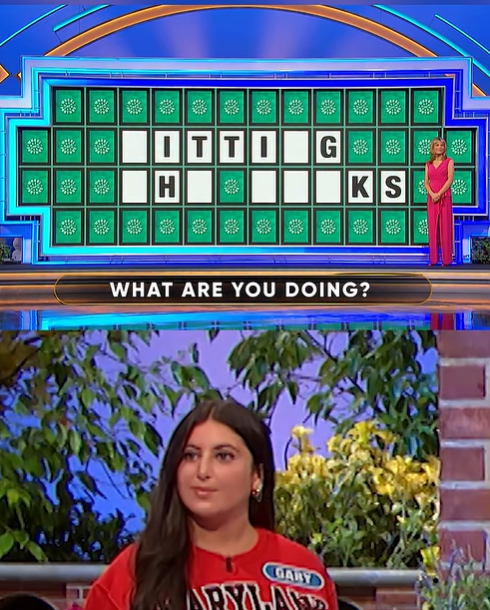
The puzzle board displays the category “WHAT ARE YOU DOING?”, suggesting that the answer describes an activity.
Several letters have already been revealed, giving viewers a promising starting point. However, the missing spaces conceal an expression that should not be interpreted literally.
The contestant studies the board, while viewers at home have the opportunity to test their own vocabulary and quick-thinking skills.
Can you identify all three words in just five seconds?
The Puzzle That Could Send Your Brain in the Wrong Direction
The board displays the following incomplete phrase:
_ I T T I _ G
_ H _ _ _ _ K S
The complete answer contains three words and 15 letters.
The first word contains seven letters, the second contains three, and the final word contains five.
At first glance, the opening word appears relatively easy to recognize. However, understanding how it connects with the remaining words is the real challenge.
The category suggests an action, but the completed expression describes something quite different from what its individual words might initially imply.
That unexpected meaning is precisely what makes the puzzle entertaining.
Three Clues That Could Help You Solve the Mystery
Before revealing the correct answer, consider these additional hints:
- The activity is particularly common among students preparing for examinations.
- It usually requires concentration, patience, and considerable mental effort.
- Despite what the first word suggests, the activity does not involve physically striking anything.
Imagine a college student sitting at a desk late in the evening.
Textbooks are scattered across the table, handwritten notes cover several pages, and an important examination is scheduled for the following morning.
Instead of watching television or going out with friends, the student decides to spend the evening studying.
What familiar English expression describes this activity?
Make your final guess before continuing.
The Correct Answer Finally Revealed
The solution is:
HITTING THE BOOKS
The completed phrase contains exactly 15 letters.
| Word | Number of letters | Missing letters |
|---|---|---|
| HITTING | 7 | H, N |
| THE | 3 | T, E |
| BOOKS | 5 | B, O, O |
| Total | 15 | 7 missing letters |
The expression perfectly matches the available spaces and every visible letter on the puzzle board.
“Hitting the books” means studying seriously or spending time reading and reviewing educational material.
It is a widely recognized English idiom, particularly associated with students preparing for examinations or completing important academic assignments.
Although the original screenshot does not show the final answer reveal, this solution fits the displayed pattern and category completely.
What Does “Hitting the Books” Actually Mean?
One of the most amusing aspects of this expression is the difference between its literal and figurative meanings.
Someone unfamiliar with English idioms might imagine a person physically hitting a pile of textbooks.
However, the expression has nothing to do with striking books.
Instead, it describes the decision to begin studying with determination and concentration.
For example, a student might tell a friend:
“I have a big exam tomorrow, so I need to hit the books tonight.”
The student is simply explaining that they must spend time studying rather than participating in other activities.
The phrase can also apply to adults preparing for professional qualifications, learning new skills, or reviewing educational material.
Its informal tone makes it particularly common in everyday conversation.
Why English Idioms Make Such Entertaining Puzzles
English contains countless expressions whose meanings cannot always be understood by interpreting each word individually.
Consider familiar phrases such as:
- “Break a leg” — wishing someone good luck.
- “Spill the beans” — revealing a secret.
- “Hit the sack” — going to bed.
- “Under the weather” — feeling unwell.
Each expression communicates a meaning that differs from its literal wording.
“Hitting the books” follows the same pattern.
For experienced English speakers, the meaning may be immediately recognizable. For someone learning the language, however, the combination of words could initially appear confusing.
This makes idioms particularly effective material for television word puzzles.
They challenge players to recognize complete expressions rather than simply identify individual words.
The One Word That Could Unlock the Entire Puzzle
An effective strategy for solving this challenge is to concentrate on the first word.
The visible pattern strongly suggests “HITTING.”
Once that word is recognized, the category “WHAT ARE YOU DOING?” encourages players to consider familiar activities beginning with that verb.
The three-letter middle word can then be identified as “THE.”
At that point, the final five-letter word becomes considerably easier to determine.
The expression “HITTING THE BOOKS” emerges naturally from the combination.
However, a player who interprets “hitting” exclusively as a physical action might spend valuable seconds searching for an entirely different answer.
The challenge rewards flexible thinking and familiarity with everyday English expressions.
A Phrase That Generations of Students Recognize
For many people, the expression brings back memories of school, university, and examination season.
Late-night study sessions, stacks of textbooks, unfinished assignments, and cups of coffee are familiar experiences for countless students.
Although modern education increasingly relies on digital resources, online courses, and electronic textbooks, the traditional expression remains relevant.
Someone can still say they are “hitting the books” even when their study materials are displayed on a laptop or tablet.
The phrase refers to the activity of studying rather than the physical format of the educational material.
That flexibility has helped it remain recognizable in modern English.
Could You Have Solved It Before the Contestant?
The enduring appeal of Wheel of Fortune lies in its ability to transform ordinary language into surprisingly entertaining challenges.
This particular puzzle does not require complicated scientific knowledge, obscure historical facts, or advanced mathematics.
Instead, it tests whether players can recognize a familiar expression while looking at an incomplete collection of letters.
Once the solution becomes clear, it seems almost impossible to imagine any other answer.
But discovering it under pressure is another matter entirely.
Perhaps the funniest part is that anyone who struggled with this challenge might need to follow the advice hidden inside the puzzle itself.
Be honest — did you solve all 15 letters within five seconds, or is it time for you to start hitting the books?