Part 2: The Home That Saved Them First
THE BIKERS FOUND 32 CATS IN AN OLD WOMAN’S ALLEY—THEN DISCOVERED THE HOUSE HAD ONCE SAVED THEIR LIVES
Part 2: The Home That Saved Them First
The animal-control officer gave us seventy-two hours.
After that, the cats would be removed.
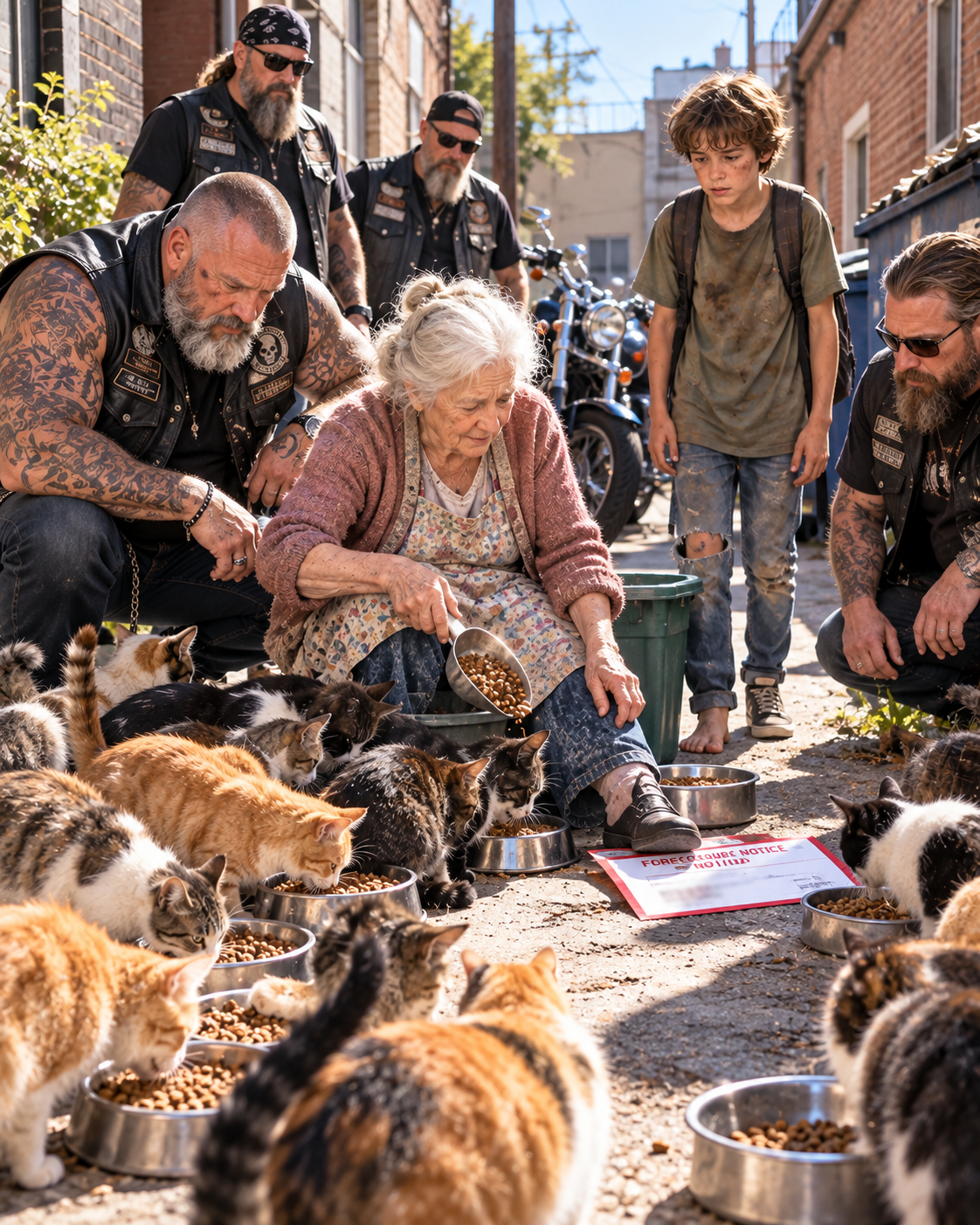
Miss Evie stood in her doorway holding the notice with both hands.
“I won’t let them take them.”
Her voice barely carried.
Brick looked at me.
Neither of us needed to say what we were thinking.
We weren’t going to let her lose the house either.
But paying off the loan wasn’t enough.
Maya, a lawyer who volunteered with our veterans’ organization, reviewed the foreclosure documents that same afternoon.
She found something strange.
The original loan documents contained an insurance clause that should have covered Miller’s emergency surgery.
But the insurance claim had never been filed.
Instead, the finance company had placed the entire veterinary balance against the property.
“Someone should have explained this to her,” Maya said.
“Can we stop the foreclosure?”
“Possibly. But we need the veterinary records, the original loan agreement, and proof that the claim was never processed.”
We had less than three days.
The club moved.
One rider contacted the veterinarian.
Another found the original lender.
Moth searched county records.
Brick went through boxes in Miss Evie’s garage.
I stayed with her.
That evening, I found her sitting beside Miller.
The cat rested against her ankle.
“You know,” she whispered, “Walter always said you boys would come back.”
I smiled sadly.
“We should’ve come sooner.”
She looked at me.
“He knew you would.”
The next morning, Maya found the missing insurance paperwork.
The claim had been rejected because the veterinary clinic had entered one digit incorrectly on the policy number.
Nobody had noticed.
The lender had never received the corrected claim.
That changed everything.
The foreclosure was temporarily halted.
But there was still a problem.
The outstanding balance had grown because of accumulated fees.
So we held a meeting at the clubhouse.
I expected the riders to argue about money.
Instead, Brick stood up.
“We aren’t buying her house.”
Everyone looked at him.
“We’re restoring what she lost.”
He was right.
The club contacted local businesses.
A veterinarian donated future emergency care.
A pet-supply store offered food at cost.
A contractor repaired the damaged roof.
A community legal clinic helped Miss Evie restructure the remaining debt.
And the riders created a small emergency fund for the colony.
Within a week, the thirty-two cats had proper medical records, vaccination schedules, food storage, and a plan approved by the local animal-welfare authorities.
Animal control never returned to remove them.
But the biggest surprise came from the county records.
The Carter property had a historic restriction attached to the deed.
Walter had registered part of the house decades earlier as a temporary youth shelter.
The legal language was old, but it was still valid.
Miss Evie’s home wasn’t merely a private residence.
It had once been designated as a community safe house.
That explained why Walter had always told frightened teenagers they could come through the back door.
And it meant the county had obligations before forcing the property into foreclosure.
With Maya’s help, the designation became part of the legal case.
The foreclosure was eventually canceled.
Miss Evie kept her home.
The cats kept theirs.
But something else changed.
The old wooden sign above the rear gate had almost completely faded.
One Saturday morning, the Iron Haven Riders restored it.
We painted four simple words across the wood:
THE DOOR STAYS OPEN.
Miss Evie watched from the porch.
“You boys are making a lot of noise.”
Brick grinned.
“Sorry, ma’am.”
She shook her head.
Then she smiled.
“Don’t be.”
Months later, the house became a registered community resource again.
Not a shelter packed with strangers.
Just a place where someone in trouble could knock and find a phone, a meal, and someone willing to listen.
And every evening, the thirty-two cats still appeared for dinner.
Maple came first.
Otis followed.
Juniper always waited near the gate.
Miller, after months of treatment, walked with only the slightest limp.
One evening, I sat beside Miss Evie on the porch.
She looked at me.
“Tall Bird.”
I laughed.
“I haven’t heard that in years.”
“You’ll always be Tall Bird to me.”
I looked toward the old house.
“I thought we came here to save you.”
She smiled.
“No.”
She pointed toward the doorway.
“You came home.”
I looked at the wooden sign.
For years, I had believed Walter saved us because he gave us somewhere to sleep.
Now I understood.
He hadn’t just opened a door.
He had taught a group of frightened kids what a safe place felt like.
And decades later, when his wife needed someone to keep that door open, those kids finally came back.
Not because they owed him.
Because they remembered.
Sometimes the greatest debt isn’t money.
It’s remembering who opened the door when nobody else would.