Part 2: The Family They Found on the Highway
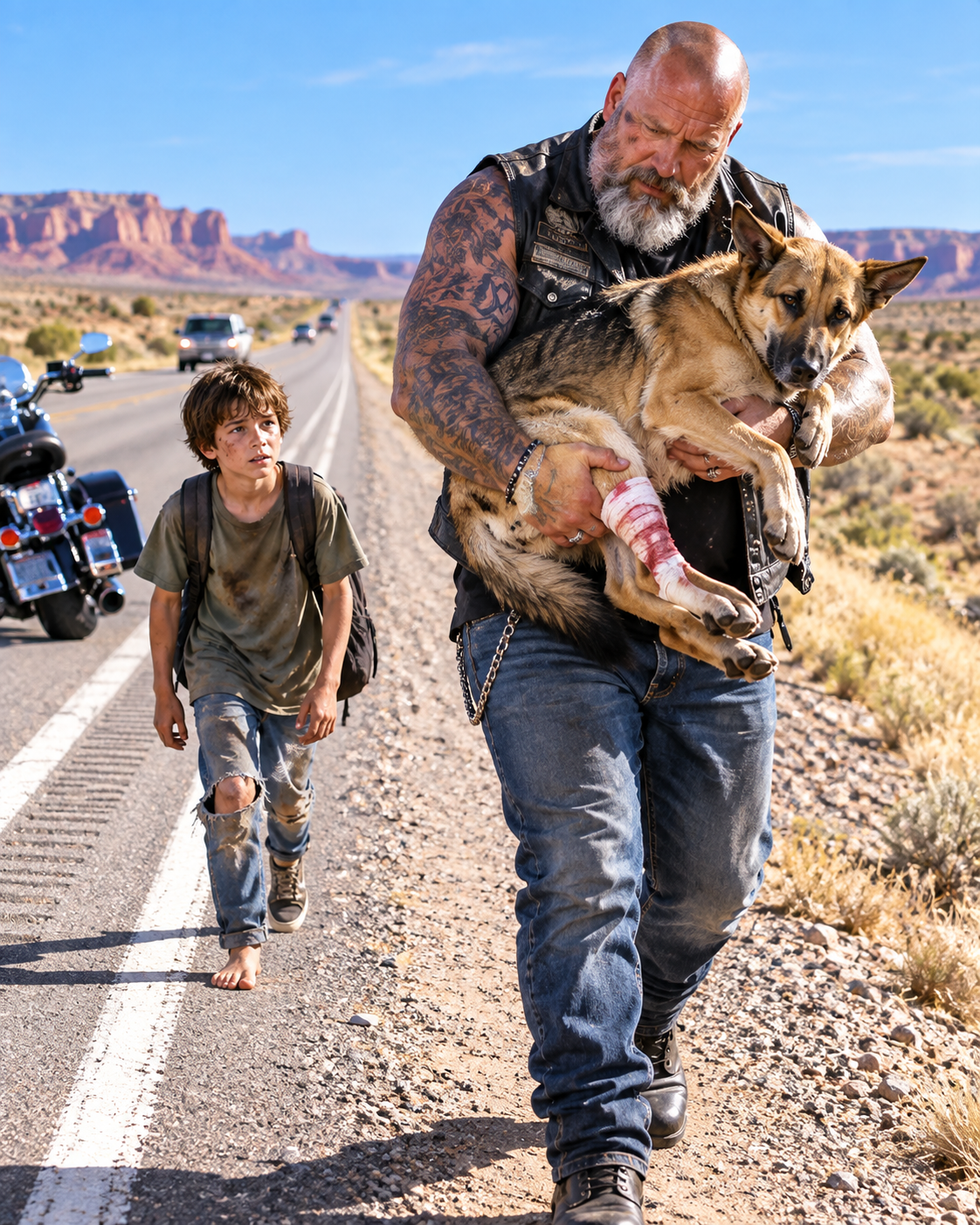
THE BIKER WHO CARRIED A BLEEDING DOG—AND DISCOVERED THE BOY FOLLOWING HIM
Part 2: The Family They Found on the Highway
The first night Caleb slept above my garage, he kept his shoes on.
He had been given clean clothes, a warm meal, and a real bed.
But he still slept with one hand wrapped around Duke’s leash.
Duke lay beside the bed, his injured leg protected by a temporary splint.
I stood in the doorway for several seconds.
“You can take your shoes off, kid.”
Caleb opened one eye.
“What if they make us leave?”
I understood immediately.
He wasn’t talking about me.
He was talking about every place that had ever promised to help him before.
“You’re not leaving tonight.”
He nodded.
But he didn’t remove his shoes.
Trust, I learned, doesn’t arrive because someone gives you a key.
Sometimes it takes months.
Sometimes years.
The next morning, I called my riding club.
I told them what happened.
I expected questions.
Instead, they showed up.
One brought groceries.
Another brought a new mattress.
Someone found a proper dog bed for Duke.
A retired mechanic installed a small heater in the garage apartment.
Nobody called it charity.
They called it looking after one of their own.
Caleb watched from the stairs.
He didn’t say much.
But when one of the riders asked whether Duke needed anything, Caleb quietly answered:
“Chicken.”
The rider laughed.
“How much?”
Caleb thought about it.
“A lot.”
“Done.”
For the first time, I saw him smile.
Duke’s surgery went well.
The recovery was slower.
So was Caleb’s.
The caseworker visited regularly.
There were interviews, background checks, home inspections, court hearings, school enrollment, medical appointments, and enough paperwork to make a grown man want to ride into the desert and disappear.
But I stayed.
Every appointment.
Every meeting.
Every difficult conversation.
When the caseworker asked whether I understood what permanent placement meant, I answered honestly.
“I do.”
She asked whether I was prepared for the possibility that Caleb might eventually want to reconnect with relatives or move somewhere else.
“Yes.”
“And if he struggles?”
“I’ll help him.”
She studied me.
“What if he pushes you away?”
I thought about the barefoot boy walking thirty yards behind me on that highway.
“Then I’ll give him space.”
That answer seemed to matter.
Months passed.
Duke learned to walk again.
Caleb returned to school.
His grades improved.
He started helping me around the garage.
At first, I gave him simple jobs.
Sorting bolts.
Cleaning tools.
Checking tire pressure.
Nothing dangerous.
But he learned quickly.
One afternoon, I found him sitting beside my motorcycle with a screwdriver in his hand.
“Don’t touch that.”
He immediately dropped it.
“Sorry.”
I smiled.
“I didn’t say you couldn’t learn.”
His eyes lifted.
“You’ll teach me?”
“Eventually.”
He smiled.
“Okay.”
A year after the highway rescue, the adoption hearing finally arrived.
Caleb wore a clean blue shirt.
Duke waited outside with one of my club brothers.
The judge asked Caleb a simple question.
“Do you want Mason Holt to become your legal father?”
Caleb looked at me.
Then he looked down.
For several seconds, he said nothing.
I didn’t pressure him.
Finally, he spoke.
“Yes.”
The judge smiled.
“Why?”
Caleb looked toward me.
“Because he didn’t just save Duke.”
His voice trembled.
“He came back.”
I swallowed hard.
The judge signed the order.
Just like that, Caleb was my son.
Afterward, we walked outside.
Duke nearly knocked Caleb over trying to reach him.
Caleb laughed.
Then he turned toward me.
“Dad?”
I froze.
I had imagined hearing that word more times than I could admit.
“Yeah?”
“Can we go home?”
I smiled.
“Yeah, son.”
We walked toward the motorcycles.
One of the riders started his engine.
Then another.
Soon the entire parking lot filled with the familiar sound of motorcycles.
Caleb looked around.
“You guys are coming too?”
Bear grinned.
“Of course.”
Caleb laughed.
A year earlier, I had stopped on a highway because an injured dog needed help.
I thought I was carrying a stranger’s animal to a veterinarian.
I didn’t know I was carrying a boy’s entire world.
I didn’t know that boy would become my son.
And I certainly didn’t know that the scared eleven-year-old following me barefoot through the Arizona heat would eventually teach me something no amount of years on the road ever had.
Family isn’t always the people who were supposed to be there.
Sometimes family is the person who stops.
The person who stays.
And the person who looks at you when you’re terrified and says:
“You don’t have to walk alone anymore.”