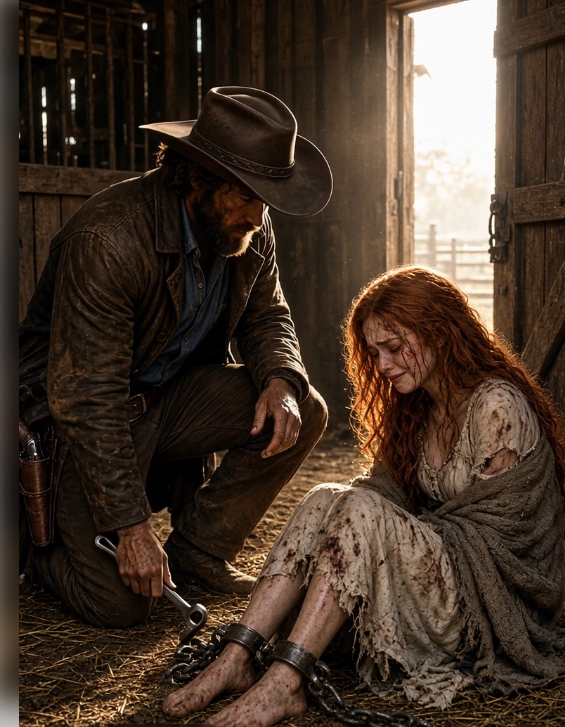
THE COWBOY BROKE HER CHAINS—THEN SHE WHISPERED, “YOU SHOULD HAVE LEFT ME LOCKED UP”
THE COWBOY BROKE HER CHAINS—THEN SHE WHISPERED, “YOU SHOULD HAVE LEFT ME LOCKED UP”
Part 2: The Dead Judge at the Barn Door
Cole stared through the crack in the barn wall.
The wanted notice said Judge Henry Vale was dead.
Yet Henry Vale was riding straight toward them.
“Start talking,” Cole whispered.
Grace swallowed.
“My real name is Mary Ellis.”
She explained quickly.
Three months earlier, Mary had worked as a clerk in Judge Vale’s courthouse. While copying property records, she discovered dozens of ranches had supposedly changed ownership after their owners failed to repay loans.
But the signatures didn’t match.
Neither did the dates.
Someone was forging deeds and using court orders to seize valuable land.
Mary traced the documents to Judge Vale.
Then she made the mistake of confronting him.
Two days later, Vale disappeared.
The sheriff announced that the judge had been murdered.
Mary became the accused killer.
“They found his blood in my room,” she said. “His watch under my bed.”
Cole understood.
“You were framed.”
Mary nodded.
She had escaped before trial.
But Vale’s men eventually caught her.
“They kept me here because they needed something.”
“What?”
Mary looked toward the barn floor.
“A ledger.”
Before fleeing the courthouse, she’d stolen Vale’s private accounting book.
It contained payments to officials, forged property transfers, and the names of ranchers targeted next.
She had hidden it before her capture.
Vale’s voice suddenly came from outside.
“Mary!”
Cole stood.
“Stay here.”
He walked into the sunlight with his hands visible.
Judge Vale stopped his horse twenty yards away.
Beside him rode Sheriff Amos Trent and three armed men.
Vale smiled.
“That’s a dangerous fugitive you’re protecting.”
Cole held up the wanted notice.
“Funny thing about that.”
His eyes settled on Vale.
“Dead men usually don’t come looking for their murderers.”
The sheriff’s expression tightened.
Vale’s smile disappeared.
“Hand her over.”
“No.”
Cole had spent ten years avoiding other men’s trouble.
But chaining a woman inside a barn had made this his trouble.
Vale reached inside his coat.
Then another voice cut across the yard.
“Keep your hands where I can see them.”
Riders emerged from behind the cottonwoods.
Deputy U.S. Marshal Samuel Reed led them.
Mary appeared in the barn doorway.
For the first time, she smiled.
Cole glanced at her.
“You expecting them?”
“I was hoping.”
The railroad receipt Cole had found wasn’t meaningless.
Before her capture, Mary had mailed a letter to a federal land office describing the fraudulent deeds. The receipt recorded where she’d sent copies of several disputed records.
Federal investigators had already begun checking her claims.
Vale hadn’t come to kill Mary immediately because he believed she still possessed the ledger.
Now Mary finally revealed where it was.
She walked to the barn’s support post—the same post she’d been chained to.
From a narrow crack beneath its base, she pulled a cloth-wrapped book.
Vale went pale.
“You chained me three feet from the evidence,” she said.
The ledger did not prove every accusation by itself.
But combined with courthouse records, handwriting comparisons, bank transactions and testimony from several ranchers, it gave investigators enough to unravel the scheme.
Vale was arrested.
Sheriff Trent was taken into custody pending investigation into his role.
The false murder accusation against Mary collapsed once authorities established that the supposed victim had been alive and participating in the deception.
Weeks later, several fraudulent property transfers were challenged and overturned through the courts.
Mary’s name was cleared.
But she didn’t immediately leave Wyoming.
One autumn morning, Cole found her standing inside the old barn.
The chains were still lying where he’d dropped them.
“Why keep those?” he asked.
Mary picked them up.
For a moment, Cole expected anger.
Instead she carried them outside and dropped them onto a blacksmith’s wagon.
“I don’t want to keep them.”
Months later, Cole discovered what she’d done.
Mary had asked the blacksmith to melt the shackles down.
From the iron, he forged a small bell.
Cole hung it above the ranch porch.
The first time the wind made it ring, Mary stopped beneath it.
Cole joined her.
“Does it bother you?”
Mary listened.
Then shook her head.
“No.”
She smiled.
“It sounds different now.”
Cole understood.
The same iron that had once told Mary she couldn’t leave now made a sound that traveled freely across the valley.
And every time that bell rang, she remembered the morning a stranger turned a key and told her she was free.
But freedom hadn’t begun when the chains fell.
It began when she finally believed she didn’t have to put them back on.