Part 2: The Number That Shouldn’t Have Been There
HER FATHER MARRIED HER OFF TO A DEAF RANCHER FOR $50—ON THE EIGHTH NIGHT, SHE FOUND WHAT WAS HIDDEN IN HIS EAR
Part 2: The Number That Shouldn’t Have Been There
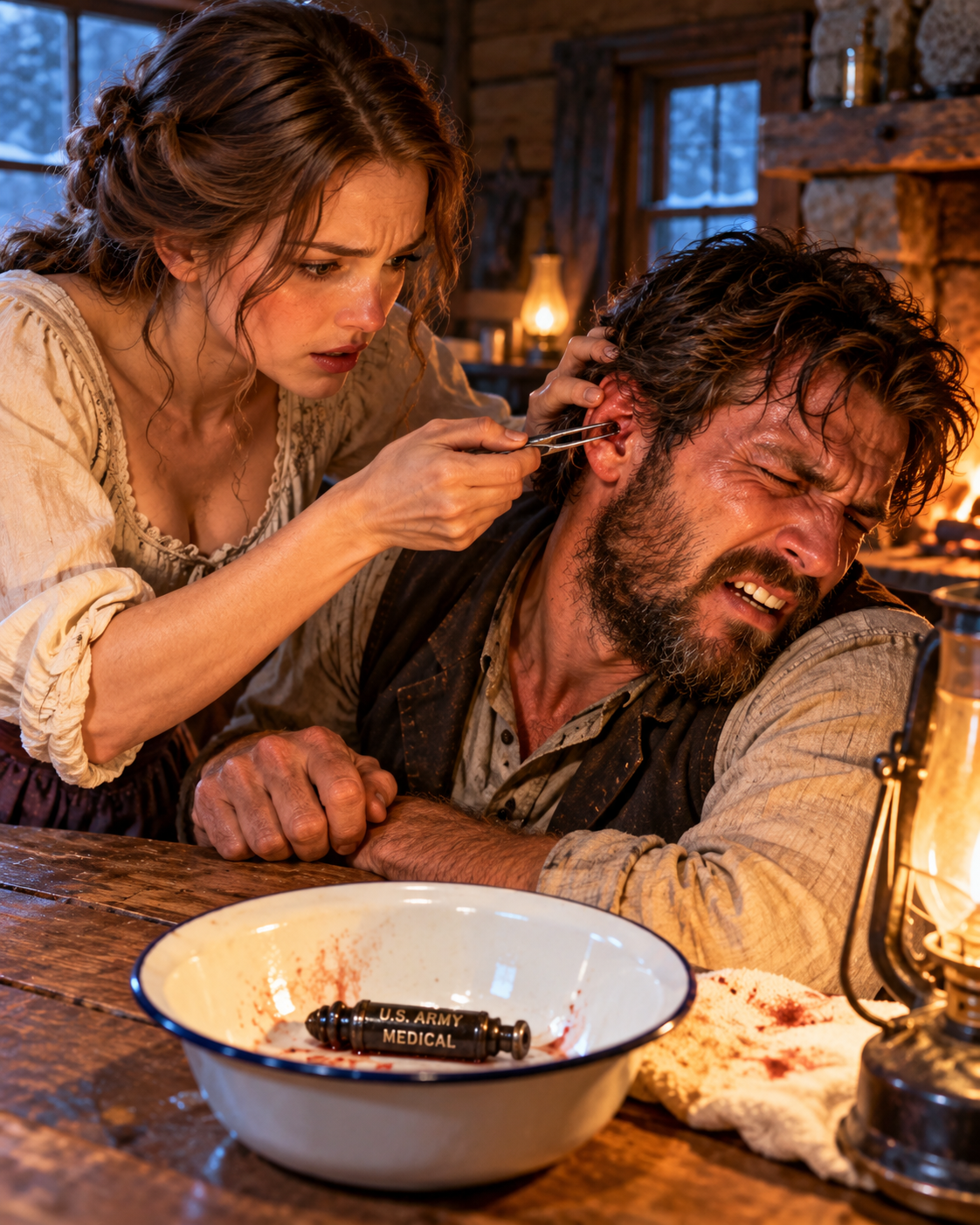
Clara turned the tiny black object beneath the oil lamp.
It wasn’t alive.
It had only appeared to move because blood and fluid had shifted around it inside Silas’s ear.
It was a narrow metal fragment.
And someone had put it there.
The next morning, Clara wrapped it in cloth and rode into Cold Creek.
Dr. Henry Bell examined the engraving.
His expression changed immediately.
“This isn’t medicine.”
“Then what is it?”
“Part of an old surgical instrument.”
He copied the serial number into his ledger.
Then he looked at Silas.
“Who treated you when you lost your hearing?”
Silas wrote:
Army surgeon. Fort Mercer. I was eleven.
Dr. Bell went silent.
Fort Mercer had closed twenty-seven years earlier.
But Bell had served there as a young medical assistant.
He remembered the surgeon.
Dr. Amos Whitmore.
Clara’s blood went cold.
Whitmore was her father’s older brother.
Her uncle.
That evening, Clara confronted her father.
The moment she placed the metal fragment on his table, all color left his face.
“Where did you get that?”
“From my husband’s ear.”
Her father reached for it.
Clara pulled it away.
“Tell me.”
The truth had waited twenty-eight years.
Silas hadn’t been born deaf.
As a boy, he’d been injured when a horse threw him near Fort Mercer. His hearing remained intact, but he suffered severe ear pain.
Dr. Whitmore operated.
During the crude procedure, the tip of a small instrument broke.
Instead of admitting the mistake, Whitmore concealed it.
Infection followed.
Silas gradually lost most of his hearing.
But that wasn’t why Clara’s father had arranged the marriage.
Years later, after Whitmore died, Clara’s father found his medical records.
Among them was a written confession describing what had happened to Silas.
He hid it.
Then Silas became wealthy.
His ranch expanded.
Clara’s family collapsed into debt.
Her father saw an opportunity.
“You sold me to him because you were afraid he’d discover the truth.”
Her father looked away.
“I thought if you married him, the matter would stay buried.”
“For fifty dollars?”
“I needed the money.”
Clara slapped the table with both hands.
“You didn’t sell me for fifty dollars.”
She pointed toward the metal fragment.
“You paid fifty dollars to keep him quiet.”
Her father had no answer.
Clara returned to the ranch with the confession.
Silas read every page.
Then sat beside the window for a very long time.
Finally he wrote:
Did you know?
Clara immediately shook her head.
Never.
Silas looked at her.
Then wrote another sentence.
You can leave. None of this was your choice.
Clara read it twice.
Then took the pencil.
Neither was what happened to you.
She remained.
Not because a marriage contract required it.
Because for the first time in her life, staying somewhere was her own decision.
Dr. Bell later removed additional scar tissue and treated the chronic infection. After nearly three decades of damage, nobody could promise Silas his hearing would return.
Some of it never did.
But months later, Clara was washing dishes when a plate slipped from her hand.
It struck the floor.
Silas turned.
Clara froze.
She picked up a spoon.
Tapped it gently against the table.
Silas’s eyes widened.
Again.
Tap.
He touched his right ear.
Then looked at Clara.
“I heard that.”
The words came slowly. His own voice was unfamiliar to him.
Clara covered her mouth.
Silas smiled.
It wasn’t a miraculous cure.
His hearing remained limited, and some days were better than others.
But there were sounds he could perceive now that had been absent for most of his life.
Rain against the roof.
A horse calling from the barn.
The crackle of the fireplace.
And one spring morning, Clara stood behind him on the porch.
“Silas.”
He turned before she touched him.
Her eyes filled with tears.
Years later, they still kept the notebook from their first eight days together.
On its final page were two sentences.
The first was Silas’s:
You never owed me anything.
Underneath it, Clara had written:
That’s why I chose to stay.
The fifty dollars her father accepted had begun their marriage as a transaction.
But it couldn’t decide what came afterward.
That choice belonged to them.