HELEN MIRREN’S HAUNTING TRANSFORMATION INTO A WARTIME LEADER REVEALS THE IMPOSSIBLE DECISIONS THAT CHANGED HISTORY FOREVER
A Nation on the Edge of Catastrophe
Some of the most devastating moments in history unfold not on the battlefield, but inside quiet rooms where exhausted leaders must make decisions that determine the fate of thousands.
A telephone rings. A military commander delivers another alarming report. Cigarette smoke hangs in the air as an aging woman studies maps covered with arrows, numbers, and increasingly desperate predictions.
Outside those walls, a nation is fighting for survival.
Inside, its prime minister is confronting an impossible responsibility.
Helen Mirren brings this extraordinary historical crisis to life in a tense political drama that explores the human consequences of leadership during wartime.
Rather than relying on spectacular battle sequences, the film concentrates on the psychological pressure surrounding a woman whose decisions could determine whether her country survives a devastating military assault.
Behind her famously stern expression lies a leader battling serious illness, political uncertainty, and the growing realization that history may remember her as much for her mistakes as for her achievements.
It is a story about the terrible burden of authority, where even the most necessary decisions can leave wounds that never heal.
October 1973: When Everything Changed
The story begins during one of the most dangerous periods in modern Middle Eastern history.
On October 6, 1973, Egyptian and Syrian forces launched a coordinated attack against Israeli positions in the Sinai Peninsula and the Golan Heights, territories Israel had occupied since the 1967 war.
The offensive began on Yom Kippur, the holiest day in the Jewish calendar.
For Israeli leaders, the scale and effectiveness of the initial attacks exposed serious failures in military intelligence and strategic preparation.
Reports arriving from the front painted an increasingly alarming picture.
Israeli defenses were under immense pressure, military casualties were mounting, and commanders were struggling to understand how their assumptions about enemy intentions had proved so disastrously wrong.
At the center of the crisis stood Prime Minister Golda Meir.
At 75, she was already carrying the physical burdens of age and illness. Yet the responsibilities of her office demanded extraordinary stamina, clarity, and determination.
As military officials debated their next moves, she was forced to consider competing recommendations, uncertain intelligence, and the potential consequences of every decision.
The film presents this atmosphere through a succession of tense meetings, telephone conversations, and moments of private exhaustion.
There is little opportunity for reflection.
Every passing hour brings the possibility of another military disaster.
Helen Mirren Disappears Into the Role
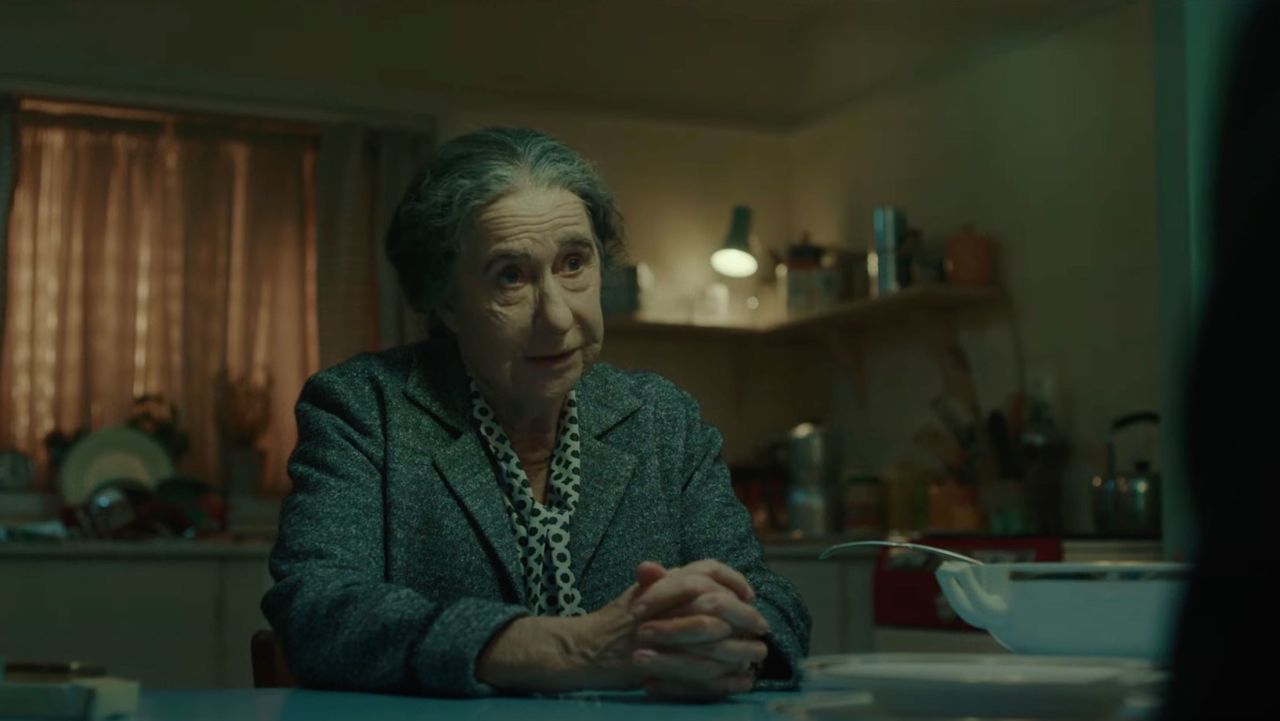
One of the most striking aspects of the production is Mirren’s physical transformation.
Through extensive prosthetic makeup, carefully designed costumes, and subtle changes in posture and movement, the actress becomes almost unrecognizable.
Her interpretation captures the distinctive appearance of the historical prime minister, from her heavy features and characteristic hairstyle to her habit of smoking cigarettes.
But physical resemblance is only part of the performance.
Mirren portrays a woman whose public composure conceals enormous personal strain.
Her movements are deliberate. Her expressions are guarded. Even when surrounded by powerful military figures, she rarely needs to raise her voice to establish authority.
Instead, Mirren communicates through controlled gestures and prolonged silences.
A momentary hesitation suggests uncertainty.
A weary glance reveals the emotional cost of another casualty report.
An exhausted expression hints at the physical pain she struggles to conceal.
The result is a portrait of leadership defined less by political grandeur than by the effort required to remain composed while events threaten to spiral beyond control.
Mirren’s performance also highlights the contradictions within her character.
She can be forceful and compassionate, calculating and vulnerable, politically determined yet deeply affected by the human consequences of war.
These tensions give the central role its dramatic substance.
The Illness She Could Not Escape
Beyond the military crisis, another struggle unfolds in private.
Meir was living with lymphoma, a cancer of the lymphatic system, and undergoing medical treatment while continuing her demanding political responsibilities.
The film repeatedly contrasts the image of an authoritative national leader with that of a physically vulnerable patient.
One moment, she is reviewing military developments and challenging senior officials.
The next, she is enduring treatment and attempting to recover enough strength to return to work.
These scenes emphasize the distance between public expectations and private suffering.
Her illness becomes an additional burden during a period when the country depends upon her judgment.
The film does not suggest that her physical condition alone explains the decisions she makes.
Instead, it uses her medical struggles to deepen its portrayal of exhaustion, isolation, and determination.
For audiences, these moments provide an intimate perspective on someone otherwise remembered primarily through political speeches, diplomatic achievements, and historical controversy.
They also reveal the film’s central dramatic approach: examining extraordinary events through the personal experience of one individual.
A War Fought Behind Closed Doors
Unlike conventional war films, this production spends much of its running time away from combat.
Military developments are communicated through reports, maps, radio transmissions, and conversations among senior officials.
The approach creates a particular kind of tension.
Viewers often experience battlefield events at the same distance as the political leaders themselves.
They hear that soldiers have been killed without witnessing every confrontation.
They learn that positions have been lost through the strained voices of commanders.
They observe officials attempting to interpret rapidly changing information while recognizing that their understanding may already be incomplete.
This restricted perspective reflects one of the central challenges of wartime leadership.
Decisions must often be made before reliable information becomes available.
And once those decisions are implemented, their consequences cannot simply be reversed.
Director Guy Nattiv turns these uncertainties into the dramatic foundation of Golda, the 2023 historical film written by Nicholas Martin.
Rather than attempting to document Meir’s entire life, the production concentrates on the roughly nineteen days surrounding the Yom Kippur War.
This narrow timeframe allows the story to explore the political and emotional pressure of a single defining crisis.
A Dangerous Diplomatic Game
As the military situation develops, international diplomacy becomes increasingly important.
The United States plays a crucial role in supplying Israel with military equipment, while the wider conflict unfolds against the geopolitical tensions of the Cold War.
In the film, Liev Schreiber portrays American Secretary of State Henry Kissinger.
His encounters with Meir introduce a different kind of confrontation.
Where military officers discuss battlefield positions and casualties, diplomatic conversations revolve around strategic interests, political leverage, and the consequences of further escalation.
Schreiber presents Kissinger as a calculating negotiator whose responsibilities do not always align with Israel’s immediate priorities.
Mirren’s Meir understands the importance of American assistance, but she must also defend what she believes are her country’s urgent security needs.
Their interactions become contests of patience and political judgment.
Neither character can simply ignore the other.
Their decisions are shaped by military realities, diplomatic relationships, and the possibility that the conflict could draw major powers into a broader confrontation.
These scenes demonstrate that wars are fought not only through military operations but also through negotiations that determine which resources become available and when the fighting might end.
The Controversial Legacy of a Leader
Although the film is sympathetic toward Meir’s personal suffering, her historical legacy remains complicated.
The Yom Kippur War exposed failures in Israeli preparedness and intelligence assessment. Despite Israel’s eventual military recovery, the initial losses generated intense public criticism.
Questions about responsibility continued long after the fighting ended.
Meir resigned as prime minister in 1974, amid the political aftermath of the conflict.
Her wider political record also remains controversial, particularly concerning her statements about Palestinian identity and her government’s approach to Palestinian rights.
These issues are important when distinguishing the historical figure from the film’s narrower portrayal.
The production primarily examines the pressures she experienced during the war, rather than offering a comprehensive assessment of Israeli policy, the broader Arab-Israeli conflict, or the experiences of all the populations affected.
That choice gives the drama a clear emotional center, but it also limits its historical perspective.
A viewer seeking a complete account of the war would need to look beyond the film.
Its central achievement lies in dramatizing a particular leader’s experience of crisis, not in resolving the political and historical arguments surrounding her decisions.
The Power of Atmosphere and Restraint
Visually, the film creates an oppressive environment.
Offices are crowded with officials, maps, and telephones.
Cigarette smoke frequently fills the frame, reinforcing the sense of confinement surrounding the central character.
Muted interiors and subdued lighting give the political spaces an atmosphere of fatigue.
Even when characters remain physically still, the possibility of catastrophe hangs over their conversations.
The film uses archival material and dramatized sequences to connect its intimate perspective with the larger historical conflict.
Its soundtrack reinforces the anxiety of a situation in which new information rarely brings reassurance.
Yet the production’s restrained approach is also one of its most divisive qualities.
Viewers expecting large-scale combat scenes or an expansive political biography may find its concentration on meetings and conversations limiting.
Some critics have argued that the heavy prosthetics and deliberately controlled storytelling prevent Mirren’s performance from fully revealing the complexity of the historical figure.
Others may find that the narrow focus gives the film a distinctive intensity.
Much depends upon whether audiences respond to its central premise: that the psychological experience of making wartime decisions can be as compelling as the battles themselves.
A Different Kind of Historical Performance
For Helen Mirren, the role represents another exploration of political authority.
Her Oscar-winning portrayal of Queen Elizabeth II in The Queen demonstrated her ability to communicate the tensions between public responsibility and private emotion.
Here, those tensions unfold under very different circumstances.
Rather than navigating a crisis of public confidence within a monarchy, she portrays a prime minister facing immediate military danger and the possibility of immense national losses.
Both performances examine the isolation that accompanies leadership.
Yet this film places far greater emphasis on physical vulnerability and the psychological consequences of decisions made under extreme uncertainty.
Mirren does not attempt to make every action admirable.
Instead, she portrays a woman who must continue exercising authority despite fear, illness, and the knowledge that some of her choices will remain controversial.
The performance is most effective when those conflicting emotions become visible beneath the character’s controlled exterior.
When Survival Comes at a Terrible Price
Ultimately, Golda is less interested in celebrating military victory than in examining the personal and political costs of war.
Its central character survives the immediate crisis, but survival does not erase the consequences of what occurred.
The casualties remain.
The intelligence failures demand examination.
The political questions continue long after the battlefield situation changes.
By focusing on Meir’s perspective, the film asks audiences to consider the difference between making decisions under extraordinary pressure and being judged for those decisions with the benefit of hindsight.
It does not provide a definitive answer to that dilemma.
Nor does personal suffering eliminate a leader’s responsibility for decisions made in office.
Instead, the drama presents an uncomfortable intersection of human vulnerability and political power.
Helen Mirren anchors that exploration with a performance built around fatigue, determination, and moments of carefully restrained emotion.
For viewers interested in historical political dramas, Golda offers an intimate interpretation of a consequential and deeply contested chapter of twentieth-century history.
Its most memorable images are not necessarily those of military destruction.
They are of an exhausted woman sitting beneath the weight of decisions that cannot be undone, surrounded by the knowledge that every choice carries consequences.
And when the crisis finally passes, one unsettling question remains:
What does victory truly mean when the human cost is impossible to forget?