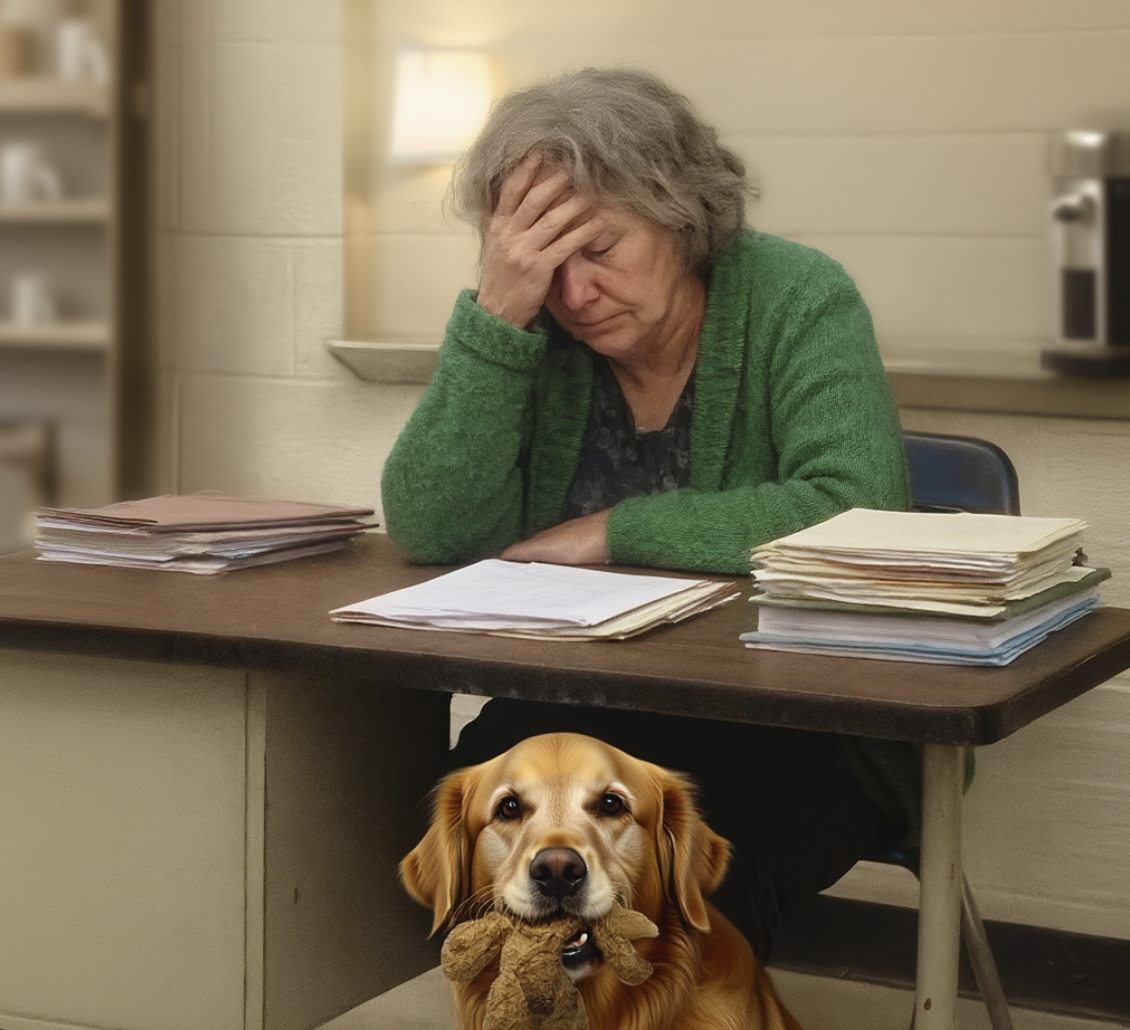
When They Said My Dog Breathed Too Loudly: The Day I Realized I Was Teaching in a World That No Longer Looked Up
The email didn’t complain about my teaching methods, my grading scale, or my curriculum. It complained that my dog, Pippin, was “breathing too loudly” and distracting a student from his screen time during recess.
That was the moment I knew. After thirty years, my time was up.
I looked down at Pippin. He was asleep under my desk, his bat-ears twitching, letting out the soft, rhythmic snores characteristic of an old French Bulldog. He didn’t look like a liability. He looked like a potato with a heartbeat. For a decade, he had been the unofficial therapist of Room 3B. But to the parent who sent that email, he was just “noise.” An interference in the signal.
My name is Margaret Hale. I teach—or I used to teach—English Literature in a suburb where the lawns are perfectly manicured, but the houses feel empty.
Today, I packed my final box.
I remember when I first started bringing Pippin to school. It was ten years ago, back when he was a puppy who couldn’t walk in a straight line. The principal at the time, a man who actually knew the names of every student’s siblings, waved it off. “If he helps the kids read, Margaret, he stays.”
And he did.
There was a boy named Tyler back in 2014. Tyler had a severe stutter. He was terrified of reading aloud. The other kids weren’t mean, but they were restless, and Tyler could feel their impatience.
So, I made a deal with him. “You don’t have to read to the class, Tyler. Just read to Pippin. He loves stories.”
I will never forget the sight of that little boy lying on the multicolored rug in the reading nook, whispering Charlotte’s Web into Pippin’s ear. Pippin just sat there, his heavy head resting on Tyler’s ankle, letting out those same soft snores. He didn’t correct Tyler’s pronunciation. He didn’t finish his sentences. He just offered a warm, living presence that said, I am here. I am listening. You are safe.
By the end of the year, Tyler stood up in front of the class and read a poem. He wasn’t perfect, but he was brave.
That was the job. That was the magic. We weren’t just teaching subjects; we were growing humans.
But the atmosphere in Room 3B has changed. It wasn’t a sudden explosion; it was a slow, silent suffocation.
The multicolored rug is still there, but it’s empty during free time. The “Reading Nook” is now just a corner where students charge their devices.
When the bell rings for recess now, there is no scramble for the kickball. There is no chaotic noise. There is an eerie, digital silence. The students stay in their seats, necks bent at a forty-five-degree angle, blue light reflecting in their glassy eyes.
They are physically here, but spiritually, they are miles away, lost in 15-second loops of noise and flashing colors.
And Pippin? He hasn’t changed. He still waddles out from under my desk when the bell rings, his little nub of a tail wiggling, looking for a hand to pet him. He craves the touch, the connection.
Yesterday, he approached a student—let’s call him K.—who was engrossed in a game on his tablet. Pippin, with his poor eyesight, just nudged K.’s leg with his wet nose, asking for a scratch behind the ears.
K. didn’t look down. He didn’t smile. He just shifted his leg, pushing the dog away with his sneaker, and muttered, “Ugh, move. You stink.”
Pippin stood there for a moment, head tilted, confused. He waited. Surely, this was a mistake? Surely, the hands would come down to comfort him? But K. had already scrolled to the next video.
Pippin let out a small sigh and walked slowly back to his bed under my desk. That broke me.
It wasn’t the rudeness. Kids can be rude. It was the indifference. It was the complete lack of empathy for a living creature standing right in front of them, begging to be seen.
We are raising a generation that can connect with the entire world via Wi-Fi, but has forgotten how to connect with the heartbeat in the same room.
When I showed the “breathing too loud” email to the new administration, I expected them to laugh. I expected them to say, “Mrs. Hale, that’s ridiculous. Pippin is an institution.”
Instead, the Vice Principal sighed, checked his smartwatch, and said, “Look, Margaret, the optics aren’t great. If the parent claims the dog is hindering the child’s educational environment… maybe it’s best to leave the dog at home. We have to be careful. Liability, you know?”
Liability. That’s what love had become. A risk to be managed.
I looked at this administrator, a man who spoke in buzzwords like “deliverables” and “stakeholders,” and I realized I was speaking a dead language.
“No,” I said softly. “I don’t think I’ll leave him at home. I think I’ll take him home. For good.”
So, here we are. 3:30 PM on a Friday.
The classroom is packed up. The walls, once covered in student artwork and inspirational quotes, are bare. The cinder blocks look cold and prison-like without the paper decorations.
I picked up the cardboard box containing thirty years of memories. A mug that says #1 Teacher. A stack of handwritten letters from the early 2000s. A dried rose from a prom in 1998.
“Come on, Pippin,” I whispered. “Time to go.”
Pippin stood up, stretching his stiff back legs. He looked at the door, then back at the empty desks. He trotted over to the corner where the toy bin used to be. He rummaged around and found it—a chewed-up, slobbery plush squirrel.
He picked it up in his mouth and brought it to me. He dropped it at my feet and looked up with those big, milky brown eyes.
We’re going to play with the kids now, right? his eyes asked. That’s why we’re packing? We’re going to find the kids who used to rub my belly?
I felt a lump in my throat so large I could barely breathe. I knelt down, my knees cracking on the hard tile, and cupped his wrinkled face in my hands.
“No, buddy,” I choked out. “Those kids aren’t here anymore.”
I clipped his leash on. We walked out of Room 3B.
The hallway was crowded with students rushing to buses. In the past, walking Pippin down this hall took twenty minutes because every child wanted to say goodbye. “Bye Pippin! See you tomorrow, Mrs. Hale!”
Today? We parted the sea of students like ghosts. No one looked up. Shoulders bumped into me. Eyes were glued to screens. White earbuds blocked out the world. We were invisible. An old woman and an old dog, analog relics in a high-definition world.
We reached the heavy double doors of the exit. The sun was shining outside, bright and real. I opened the car door, and I had to lift Pippin onto the seat. He’s too old to jump now.
As I sat in the driver’s seat, I looked back at the school one last time. It’s a good building. It’s well-funded. The technology is state-of-the-art.
But as I looked at the windows, I didn’t feel the warmth I used to feel. I realized that we aren’t just losing teachers. We aren’t just losing “the good old days.”
We are losing the softness. We are trading the messy, beautiful, tangible connection of a dog’s fur or a teacher’s hand for the sterile, dopamine-hit perfection of a pixelated screen.
I started the engine. Pippin let out a heavy sigh and rested his chin on my thigh. I stroked his head, feeling the solid warmth of him.
“It’s just us now, Pippin,” I said. “Let’s go find a place where people still look up.”
To the parents reading this:
The next time your child walks past a dog, or a teacher, or a grandparent… tell them to put the screen down. Tell them to look. Tell them to touch. Tell them to say hello.
Because eventually, the people—and the dogs—who are willing to wait for them to look up… will be gone.
And you cannot download a replacement for a soul that loved you.