When the Switch Broke
For 1,825 days, Ranger was a lethal weapon with a perfect off switch. But last night, the switch broke, and I walked through my front door into a war zone in my own living room.
In the suburbs, they tell you a security system is a keypad on the wall and a monthly fee. I never bought into that. My security system breathes, has four legs, and sleeps at the foot of my bed.
His name is Ranger. He’s a Siberian Husky, seventy-five pounds of dense fur, raw endurance, and iron discipline learned the hard way. He’s a retired dual-purpose K9—trained to detect threats and confront them. When I adopted him five years ago, his file was thick, stamped with warnings like high drive and intense.
For sixty months, he was flawless.
He never barked at the mail carrier. Never begged at the table. He treated my five-year-old daughter, Sarah, like a protected asset. If she moved, he repositioned. If she slept, he guarded. He paid his rent in absolute peace of mind.
Until yesterday.
It was the Fourth of July.
For most people, it’s celebration. For dogs like Ranger, it’s war. Explosions without context. Noise without warning. Usually, he handles it. He’s endured storms that rattled windows. But every soldier has a breaking point.
We left him inside for a block party. Cool house. Blinds closed. Music playing softly. I thought the bunker was secure.
At 10:00 p.m., we came home. The air smelled of sulfur. Fireworks cracked illegally down the street.
I opened the door and froze.
The foyer looked bombed. The living room was worse. My leather chair was shredded, foam scattered like snowfall. Claw marks gouged the drywall to bare studs. Blood smeared the trim.
“Where is he?” my wife whispered, pulling Sarah back.
I wasn’t afraid of Ranger.
I was afraid for him.
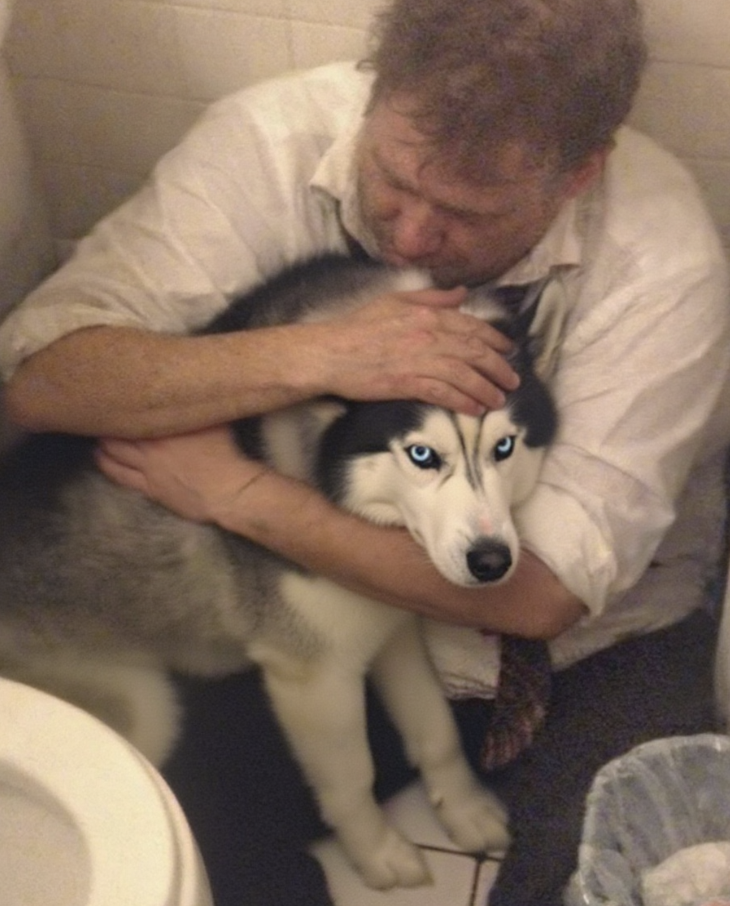
I found him in the bathroom, wedged between the toilet and tub, pressing his body into porcelain. His thick Husky coat was soaked with drool. His eyes were blown wide, black with panic.
He growled.
“He snapped,” Lisa whispered. “Is he safe?”
I looked at his eyes.
I didn’t see aggression.
I saw terror.
The same look I’d seen in soldiers when the world collapsed around them.
“Take Sarah upstairs,” I said.
I sat on the tile floor. No leash. No yelling. I removed my watch and set it aside. I blocked the exit but gave him space.
Fireworks boomed again. Ranger flinched violently, claws scraping tile.
“Easy,” I whispered.
I extended my hand. Slowly, he pressed his cold nose into my palm. His heart was hammering.
I pulled his head to my chest, wrapping my arms around his thick neck. Blood from his torn nails stained my shirt.
“I’ve got you,” I told him. “Stand down.”
For two hours, we stayed there. Every explosion outside, I tightened my grip, becoming his shield.
By 1:00 a.m., the noise stopped. Ranger exhaled—a long, broken breath. He licked my chin once.
I cleaned his paws. Treated his nails. He trusted me again.
Morning came like nothing happened.
The house was still wrecked. The chair was gone. Repairs would cost thousands.
Ranger walked outside, checked the perimeter, and sat by the oak tree—back on duty.
“What are we going to do?” Lisa asked.
“We’ll buy a new chair,” I said. “Cheaper this time.”
“And Ranger?”
“Ranger stays.”
He looked back at me through the glass. We held eye contact—two veterans who understood duty.
I lost a chair last night.
I kept my best friend.
Sometimes the most valuable things aren’t what you buy.
They’re what you refuse to abandon when the switch breaks.