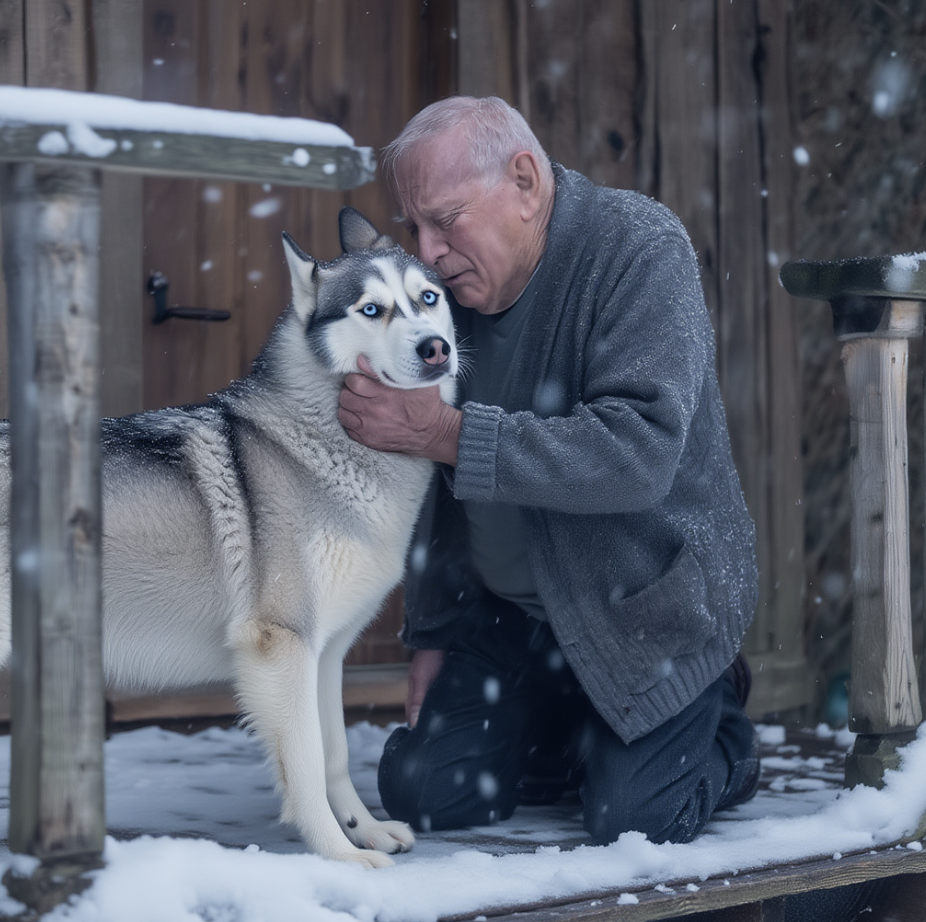
Three Taps in the Snow
The dog I’d already said goodbye to knocked on my back door.
Three small taps—polite, almost apologetic—then the soft scrape I’d trained myself to stop hearing. Wind chimes clinked like teeth in the dark, the furnace coughed itself quiet, and the house settled the way old bones do before a storm. I was off the couch before my knees remembered they were seventy-eight.
“Who’s there?” I asked a door that had answered no one since my wife died.
A whine slipped through the wood—thin, breathy, unmistakable.
“Scout?”
The name cracked me open. I threw the deadbolt and the night rushed in: cold rain, creek-water air, the smell of wet leaves and somebody’s laundry soap three streets over. And there he was on the mat—soaked and shivering, one ear bent wrong, his whole back half wagging hard enough to slide him sideways.
He was a Husky now, or always had been, I supposed—the kind of dog with winter in his bones. Blue eyes clouded at the edges from age, coat thick and clean despite the storm, tail curled like a question mark he never stopped asking.
“Buddy,” I said, uselessly, because the word had to come out before my breath could.
He pressed his forehead to mine, the way he did after my doctor said atrial fibrillation last spring and I stood in the kitchen pretending to be brave. I buried my face in his neck. He smelled like mud and rain and Dawn dish soap—the blue kind my daughter buys with coupons. My hands knew every rib and old scar, but there was something new: a tiny ridge beneath the fur at his shoulder blade. A little door under the skin.
A microchip.
We’d had one put in him when my wife was alive, but that one sat lower. This was… different.
He was heavier. Cleaner. Someone had brushed him regularly. Someone had fed him better than I do on a good month. His collar was gone, but his coat had the promised look of a dog with a schedule.
A year. He’d been gone a year.
“Okay,” I told him, and maybe myself. “We’re going to Doc Laird.”
There’s one light you can trust in our town after midnight besides the Waffle House sign, and it burns over Doc Laird’s clinic. He’s stitched half the farm dogs in the county and put down more than he’ll admit. He was there in jeans and an Ohio State hoodie, hair sticking up like the storm had followed me inside.
“I’ll be,” he said softly when he saw Scout. “Well, hell. Let’s see what the world did to you, fella.”
He warmed a towel while I signed my name with hands that shook like they used to when I quit cigarettes. Scout stood on the exam table as if he remembered how this goes. The scanner chirped over his left shoulder. Nothing. Doc angled it. The reader beeped—sharp and bright—over the new spot.
“New chip,” Doc said. “Old one probably migrated or died. Happens.” He frowned at the screen. “This is odd.”
The display didn’t show a name or a number. Just a folder icon and a label: HOME.
“You want me to—?” Doc asked.
“It’s my dog,” I said, meaning I’d already lost too many things without explanations. “Please.”
He plugged the reader into his ancient laptop with a cord he apologized for like it was a sin to still use cords. The folder opened. Inside were files stamped with dates, each a tiny thumbnail of crooked video.
“You ever seen a chip record video?” Doc asked.
“No,” I said. “But he always did know where the treats were.”
We clicked the most recent clip. The view was low, behind fur. A kitchen I didn’t recognize—laminate counters warped like tired siding, a fridge crowded with school papers, a blue lunchbox with a faded dinosaur. The oven clock read 5:14. A boy coughed—a tight whistle I’d heard in too many winter churches. A woman’s hand trembled as it set down a bottle of pink medicine. Somewhere off-camera, a drawer slammed hard enough to make the image jump.
“Scout,” a small voice whispered. “Shh.”
My heart misfired. He knew his name in that house, too.
The next clip played. Same room. A man’s voice farther away, sour with either beer or bitterness. “Where’s my keys?” The lens shifted, as if Scout turned his head. Through a window beyond a plastic plant, I caught a blue mailbox with a white 7.
The third clip was shorter. The woman’s wrist reached toward the camera, and I saw it: a bloom of yellowing bruises half-hidden by a cuff. The boy whispered again, thinner this time: “Tomorrow… five fifteen.”
Doc’s hand hovered over the keyboard. Rain rattled the gutters. The exam-room clock carved up the night.
“This,” he said slowly, “is coming from the chip in your dog.”
I nodded because the floor would be a long way down if I didn’t. “Can you tell who put it there?”
He shook his head. “Some of these are experimental—memory prompts, cues. They’re not supposed to… record anyone. Not like this.”
“Is it legal?”
Doc looked at Scout, not at me. “There’s what’s legal and there’s what’s right.”
We copied the folder to my phone like two kids stealing cookies. Back home, I dried Scout with my wife’s yellow towel and made him a bed from the afghan she crocheted the summer the mill closed. He curled into a tight crescent, eyes open until he knew I wasn’t going anywhere.
I tapped the last clip again. “Tomorrow… five fifteen.” Then scraping, a jolt, and the man’s voice—closer now, ugly with heat: “Where the hell are you?”
The clip died.
Outside, the wind nudged the chimes once. Then—clear as a sound I’d taught a pup a lifetime ago—a whistle slid through the dark. Three notes. The three I used when he was young. The three I’d heard in the video.
Scout lifted his head. Ears forward. Blue eyes fixed on the fence.
The whistle came again.
Not from my phone. Not from my memory.
From the alley behind my house.
Scout pressed his shoulder to my knee. I reached for the porch light and held my breath as the dark leaned closer, listening back.