The Witness in the Quiet
People pick us for the highlight reel—the frisbee catches in the park and the Christmas card photos—but they keep us for the nights when the silence in the kitchen gets too loud to bear alone.
My name is Barnaby, and I am a Golden Retriever. For twelve years, I have been a good boy. But more importantly, I have been a witness.
When I was a puppy, my paws were too big for my body and my understanding of the world was limited to the perimeter of the backyard fence. I thought my job was simple: retrieve the tennis ball, bark at the squirrel that taunted me from the oak tree, and wait for the sound of kibble hitting the ceramic bowl. I thought humans were simple, too. I thought the Tall One (Mark) existed to throw things, and the Soft One (Sarah) existed to scratch that impossible-to-reach spot behind my ear.
I was wrong. Humans are not simple. They are fragile, leaking vessels of worry that they try desperately to plug with noise and busyness. And my job wasn’t to fetch. My job was to hold them together when the glue started to dry out.
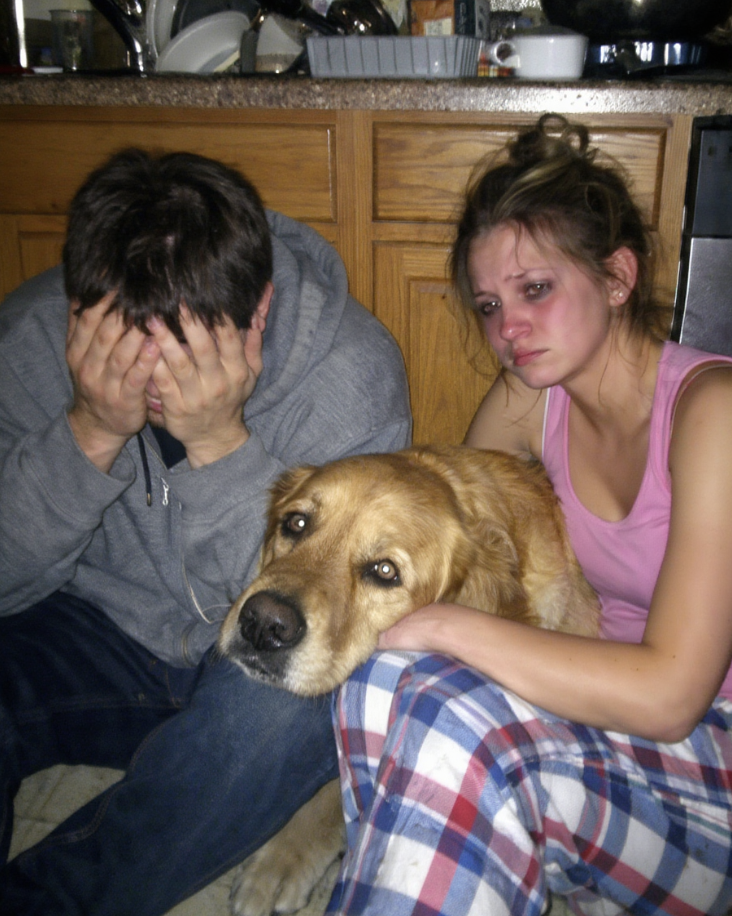
It started in the Spring of my life, which coincided with the winter of their bank account. We lived in a starter home that smelled of fresh paint and old anxiety. I remember a Tuesday night when the furnace died. The house was freezing, the air biting at my nose. Mark sat at the kitchen table, his head in his hands, staring at a stack of papers that smelled like fear. Sarah was pacing, the friction of her socks on the linoleum creating a rhythm of panic.
They were fighting, though not with shouting. They were fighting with sharp whispers, the kind that hurt my ears more than thunder.
“We can’t fix it, Mark. We just can’t.”
“I’ll pick up extra shifts. I’ll figure it out.”
“You’re already exhausted.”
I didn’t understand the words, but I understood the energy. The air in the room was static, charged with a sorrow so thick I could taste it. A younger, less experienced dog might have brought a toy to break the tension. I didn’t. Instinct took over—an ancient directive written in my DNA.
I walked over to Mark and shoved my cold nose under his elbow. I forced his hand onto my head. Then I leaned my entire eighty-pound weight against Sarah’s shin. I became a physical bridge between them. I let out a long, heavy sigh, the kind that vibrates through the ribs.
Mark looked down. His fingers curled into my fur. Sarah stopped pacing and sat on the floor next to me. They didn’t fix the furnace that night. They just huddled together on the floor with me in the middle, a hairy, golden radiator generating the only warmth that mattered. That was the first time I realized: I wasn’t a pet. I was the anchor.
Then came the Summer years. The house filled up. First came Leo, then Mia. The Quiet was replaced by the Chaos.
My coat was constantly sticky with unauthorized jam samples. My tail was a hazard to low-flying toddlers. The Minivan appeared in the driveway, a beast that swallowed the family every morning and spit them out every evening, exhausted.
This was the era of the frantic rush. The humans stopped looking at each other; they only looked at schedules. “Did you buy the milk?” “Who is picking up Leo?” “I’m late.”
I watched from the carpet, my chin on my paws. I saw things they missed. I saw Leo crying in the laundry room because he struck out at the baseball game, hiding his face in my neck because I was the only one who wouldn’t give him a pep talk. I just licked the salt from his cheek and let him know that, to me, he was the MVP because he dropped ham under the table.
I saw Sarah standing at the sink, staring out the window at nothing, the water running cold over dishes she had already washed. She was lonely in a house full of people. I would trot over, my claws clicking on the hardwood, and press my side against her leg. She would snap out of it, look down, and whisper, “Okay, Barnaby. Okay.”
We had a routine, she and I. When the arguments about budgets or in-laws flared up in the bedroom, I would patrol the hallway. I wasn’t guarding the house from burglars; I was guarding the pack from falling apart. I would whine at the door until one of them came out to let me into the yard. They would stand there in the moonlight, waiting for me to do business I didn’t need to do, and in that silence, they would breathe. The cool night air would cool their tempers. By the time I trotted back in, the fight had usually evaporated, replaced by the truce of exhaustion.
I aged. The golden fur around my muzzle turned the color of frost. My hips began to complain when it rained. This was my Autumn.
The house changed again. The noise receded. Leo packed bags and left. Mia followed two years later. The rooms that once smelled of gym socks and cheap body spray now smelled of dust and lavender. The Minivan was traded for a sensible sedan.
The silence returned, but it was different now. It wasn’t the anxious silence of the broke early years. It was a heavy, hollow silence.
Mark and Sarah sat on the couch, two islands in a sea of beige upholstery. They had spent twenty years focusing on the kids; now that the kids were gone, they had to remember how to look at each other.
One evening, a song came on the radio—something old, from the time before the furnace broke. Mark stood up. His knees popped, a sound that mimicked my own joints. He held out a hand to Sarah.
“Dance with me,” he said.
“In the kitchen? We’re old, Mark.”
“Humor me.”
I watched from my bed in the corner. They swayed past the refrigerator, past the stove, past the history of a thousand meals and a million worries. They weren’t perfect dancers. They stepped on each other’s feet. But they were holding on.
I thumped my tail against the floor—thud, thud, thud. A metronome of approval. They looked at me and laughed.
“Look at Barnaby,” Sarah said, her voice soft. “He’s still smiling.”
I was. Because I knew we had made it. We had survived the poverty, the chaos, the noise, and the silence. We were a pack again. Just the three of us.
Now, it is Winter.
My legs don’t work the way they used to. The stairs are a mountain I can no longer climb. The vet, a nice man who smells like disinfectant and peppermint, talks to Mark and Sarah in low, gentle tones. I hear words like “quality of life” and “time.”
I am not afraid. A dog knows when the sun is setting.
But they are afraid. I can smell it on them—acrid and sharp. Mark is crying. I haven’t seen him cry since the day his father died. Sarah is stroking my head, her tears wetting the fur that has lost its shine.
I want to tell them it’s okay. I want to tell them that they don’t need to worry about me. I have completed my shift.
You see, they think they took care of me. They think they rescued me from that shelter twelve years ago. They bought the premium kibble, the orthopedic bed, the squeaky toys. They paid the vet bills. They opened the door.
But they have it backward.
I was the one who took care of them.
I absorbed their stress so it wouldn’t poison their hearts. I listened to the secrets they couldn’t tell each other. I barked at the shadows so they could sleep without fear. I forced them to walk in the fresh air when they wanted to rot on the sofa. I gave them a reason to be kind when they felt like being cruel.
I watched them turn from frightened kids playing house into a gray-haired team that moves in sync. I raised them. And they turned out just fine.
The needle is coming now. The room is quiet. It is the peaceful quiet, the kind that comes after a long, hard day of work.
I look at Mark. I look at Sarah. I muster the last bit of energy in my tired tail for one final thump against the metal table. Thud.
I am here. You are safe. You are good.
The darkness is coming, but it is not cold. It feels like the spot behind my ear. It feels like the nap in the sun.
If you are reading this, and you have a dog at your feet, do not look at them as a pet. Look at them as a timekeeper. We are not here to guard your house; we are here to guard your humanity. We are the only living things on this earth that will witness your worst moments—your ugly crying, your petty fights, your morning breath, your grief—and answer it with absolute, unwavering adoration.
Go to them. Burry your hands in their fur. Feel the beat of a heart that beats only for you.
And remember: The miracle isn’t that we live so briefly. The miracle is that in our short time, we teach you how to love for a lifetime.
My watch is ended. The house is yours to hold now. Be good to each other.