The Unseen Burden
The first thing I noticed wasn’t that my father couldn’t stand up to greet me—it was that my dog, Buster, didn’t even try. That was the punch to the gut I wasn’t ready for.
I had driven six hours straight to make it home for Thanksgiving, my head filled with a highlight reel of the “good old days.” You know the ones: Dad in his prime, tossing a football with a spiral so tight it whistled; Mom commanding the kitchen like a general; and Buster, our Golden Retriever, a blurred missile of gold fur tearing across the backyard.
I parked my rental car in the driveway and walked in, expecting the usual chaos.
Instead, I found silence.
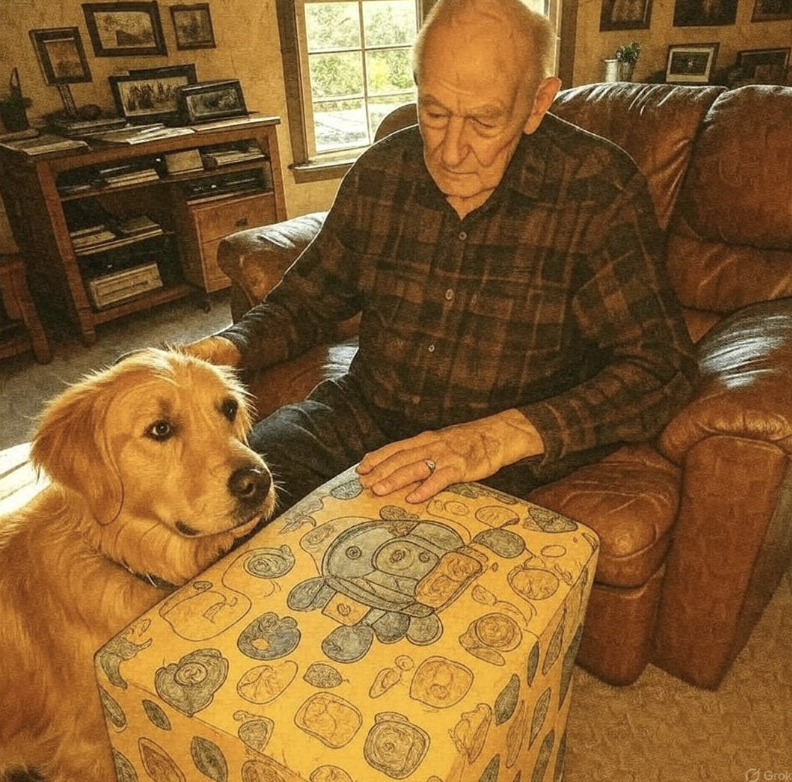
Dad was in his old leather recliner—the one that’s been in the living room since the late 90s. The TV was low. And there was Buster. Not at the door, but curled up at Dad’s feet.
“Hey, kiddo,” Dad said. His voice was thinner than I remembered, like worn fabric. He reached for the lever to pop the recliner down, and I saw the wince. A sharp, quick intake of breath.
Before I could rush over, the pile of fur at his feet stirred.
Buster stood up. It wasn’t the explosive jump I remembered. It was a process. Front legs first, trembling slightly, then the heavy heave of the hips. He didn’t come to me. He stood right next to the chair, pressing his side firmly against Dad’s calf.
Dad put his hand on Buster’s head, using the dog’s sturdy frame as a brace to push himself up.
“We’re moving a little slower these days, Mark,” Dad smiled, patting the dog’s graying muzzle. “Aren’t we, buddy?”
Buster looked at me. His eyes, once bright and mischievous, were cloudy with cataracts. He gave a single, slow thump of his tail. A greeting. An apology.
Over the next two days, the nostalgia I had brought with me began to crack.
I watched them. It was a choreography of survival. When Dad walked to the kitchen for water, Buster walked with him—matching his pace step for stiff step. If Dad stopped to catch his breath, Buster stopped, leaning in to offer support.
I remembered when I was twenty, leaving for the city. I had hugged Buster and told him, “Take care of him for me.” I said it casually. I said it like it was a game.
I didn’t realize Buster had taken it as a sacred vow.
The breaking point happened on Friday night.
I was in the kitchen getting a glass of water. The house was dark. I heard the creak of the floorboards in the hallway.
Dad was making his way to the bathroom, navigating the shadows. He misjudged the transition from the carpet to the hardwood. His foot slipped.
My heart hammered against my ribs as I started to run, but I wasn’t fast enough.
Buster was.
The old dog had been shadowing him in the dark. As Dad pitched sideways, Buster didn’t bark. He simply stepped in. He wedged his body between Dad and the wall, taking the full weight of a grown man on his arthritic hips.
Dad grabbed the hallway table to steady himself, letting out a shaky breath. He looked down. Buster let out a low groan—not a growl, but a sound of exertion—yet he didn’t buckle. He held his ground until Dad was steady again.
“I’ve got you, old man,” Dad whispered, scratching Buster’s ears. “I’m okay. We’re okay.”
I stood in the kitchen doorway, unseen, gripping my glass until my knuckles turned white. Tears stung my eyes, hot and fast.
I realized then that I had been mourning the loss of the “strong father” and the “playful puppy” from my memories. I was so busy missing who they were, I had failed to see the incredible heroism of who they are.
While I was out building my career, chasing promotions, and “becoming a man,” my dog had become the son I wasn’t there to be. He had absorbed the blows of time so my father wouldn’t have to face them alone. He had grown old, his joints aching, his eyes dimming, purely in service of the man who once threw the ball for him.
The next morning, I didn’t rush to pack up.
I went out to the back porch. Dad was sitting on the swing, a mug of coffee in his hand. Buster was lying on the sun-warmed wood next to him.
I sat down on the other side of Buster. I didn’t say anything about the slip in the hallway. I didn’t talk about my job or the city.
I just reached out and rested my hand on Buster’s neck, feeling the slow, steady rhythm of his pulse. Then, I reached over and took Dad’s hand.
We sat there for a long time, watching the wind strip the last few leaves from the maple tree.
We think love is the big moments. The home runs, the promotions, the grand reunions. But as I looked at the gray hairs on my father’s head and the snowy face of my childhood dog, I realized I had it all wrong.
Love is the slow walk.
It’s the willingness to slow your pace to match someone else’s.
It’s being the shoulder—or the flank—that someone leans on when they stumble in the dark.
Time takes everything from us eventually. It takes our speed, our strength, and our youth. But it can never take the grace of simply being there.
I can’t stop them from aging. But I promised myself, right then and there, that I would visit more. Not to fix the house. Not to offer advice.
Just to walk with them. Even if we don’t get very far.