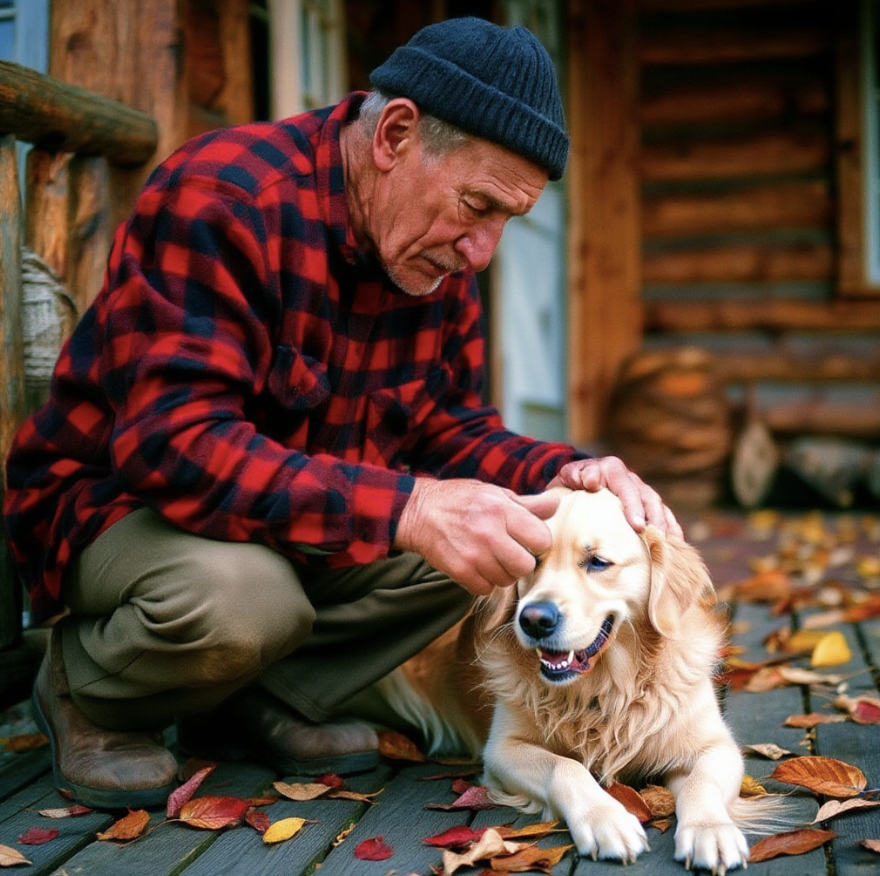
The Red Thread at Daybreak
At daybreak, an old rancher followed a ragged red thread through frost and coyote song, finding the price of loyalty at his fence—and a secret waiting by the creek; the air already carried the clean bite of iron.
The morning he found Blue, the air had that bite.
December 6, 2001, Wallowa County, Oregon. The mountains wore a thin veil of snow, and the pasture lay glazed with frost, like breath held too long.
Thomas Ray Bennett walked the fence line with the careful pace of a man counting steps he knew he couldn’t earn back. One hand stayed deep in his coat pocket, wrapped around a small bone whistle, polished smooth by years, weather, and the warmth of his palm.
“Blue,” he called, though at sixty-eight he understood how mornings worked.
Things you love stop answering one day, and the world doesn’t file a complaint.
Blue had been a Golden Retriever, pale-gold and thick-coated, the color of late wheat. Age had thinned his hips and silvered his muzzle. One eye clouded like old glass; the other still caught light and held it. A white blaze crossed his chest where scars slept like quiet lightning.
Blue had outlived Thomas’s wife, Martha Louise Bennett, by four winters. Since then, he’d taken to sleeping on the porch steps, front paws crossed, watching the dark come and go as if night itself were a duty assigned to him.
Coyotes had sung hard the night before, close enough to scratch the air raw. Thomas had stood in the doorway and blown one sharp note through the bone whistle—a thin sound that always brought Blue in.
Blue had come, pressed his cool muzzle to Thomas’s knee, then looked back into the dark with a sorrow that seemed thoughtful, not afraid. Thomas had rubbed the dog’s ear and said, “Come inside, old boy,” and Blue had refused—not stubbornly, but with the calm of a servant finishing his last task.
Now he lay at the north fence, shaped into stillness by cold.
Blue’s head was turned toward the chicken yard. His ribs showed faintly beneath winter fur. His jaw hung slack. His forelegs were braced, as if he’d tried to stand one more time and decided the ground would have to come to him.
Thomas knelt, frost cracking under his knees.
He set his hand on Blue’s brow and felt the cold move through his palm, up his arm, and into a place inside him that had no name.
“Good boy,” he said, because some words belong to particular lives and must be spoken. They came out rough and thin, like wire dragged through a knot.
A tuft of coyote fur snagged the lower strand of barbed wire—dull gray, black-tipped. In the frost below was a smear where something had been grabbed and held, right at the dog’s last reach.
Iron filled Thomas’s mouth.
He looked toward the coop and saw the hens already stirring, safe, unaware of the cost paid on their behalf.
He ran his thumb along Blue’s chin and felt the short whiskers comb his skin. He remembered the first day—an oversized puppy with feet too big for his body, leaning his whole weight into Martha’s calf and claiming her as territory.
Martha had tied a faded red bandanna around Blue’s neck that spring, laughing when he shook his head like a boy embarrassed by his mother’s fussing. The bandanna was still there, worn soft, the knot polished by weather and a thousand pats.
“I should have kept you in,” Thomas said, though he knew Blue had never belonged to doors.
Some creatures are made to hold a line, and they hold it even when no one is watching.
He drew the bone whistle from his pocket. It had been his father’s once, carved from a steer’s leg—a shepherd’s whistle that could carry a note across a quarter mile of grass and wind.
He lifted it to his lips and did not blow.
Sometimes sound is the worst kind of truth.
Far off, a pickup rattled along the gravel road, like somebody else’s life passing by. Thomas thought of his son, Michael Roy Bennett, in Boise—a man who spoke to his father now through Christmas postcards and the pale circle left where a photograph had been.
“Don’t start the ledger,” Thomas told himself.
Regret is just counting beans you can’t eat.
He slid his arms beneath Blue’s weight. Old as the dog was, he felt heavier than he should have been, as if kindness gains weight the longer it’s carried.
Thomas lifted and staggered half a step—and then he saw it.
Caught on the barb was not fur this time, but a thin red thread. Wool. Yarn. Farther down the fence, another torn loop glimmered faintly in the frost.
He set Blue down gently and followed the line, boots cracking the white skin of grass. In the frost appeared smaller prints—not coyote, not deer—too narrow, too careful, heel pressed first, toe light.
Children leave tracks like that when they’re trying not to be seen.
The trail led away from the coop, across the pasture, toward the creek. Another red loop clung to the wire, the same tired shade as Blue’s bandanna.
The barnyard quiet folded in on itself.
Thomas looked back at Blue, at the line the dog had chosen to die on, and understood that a single night can hold more than one story.
He tucked the whistle away and followed the trail through grass that whispered like paper. The creek cut a dark seam beyond the willows, black water threading beneath a thin crust of ice.
At the last fence post, a mitten string hung in two frayed ends—red, child-sized, stiff with frost—pinched between the barbs as if caught by a careful hand in a hurry.
Thomas stepped into the willow shade and heard it.
Not wind. Not a bird.
A thin human sound, tight with cold and courage, trying not to be heard and begging to be found.
He looked back once toward the field where Blue lay.
Then he pushed forward, through willow and shadow, toward the creek—toward the sound that did not belong to a winter morning.
What Blue had held the line against in the dark had not been coyotes alone.
And from beyond the bend came one small, breaking word, carried on a breath Thomas almost missed:
“Help.”