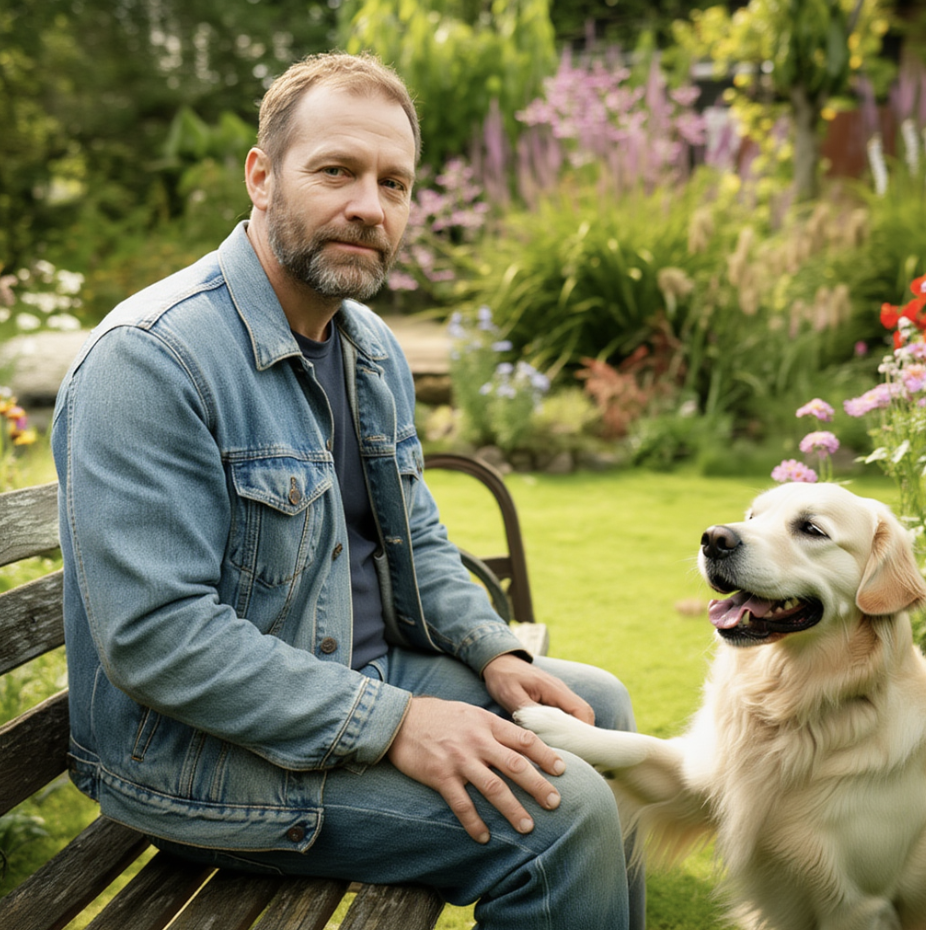
The Bench That Remembered
I had never taken him to this park, yet the Golden Retriever pulled me straight to the bench where I’d proposed to my wife.
The paint had peeled into soft curls, the view of Maple Falls running brown after last night’s rain. I hadn’t sat here since Elena’s funeral. I’d told myself I wouldn’t. Grief is a place, and I’d already lived in it too long.
The dog sat without being asked. He wasn’t supposed to be mine. The shelter had named him June—soft fur around the ears, a single freckle on the pink of his nose like a thumbprint. I’d only gone out there to fix a flickering exit sign. I left with paperwork and this animal leaning his weight into my shin like we’d been practicing for years.
June lifted a paw, hesitated, and set it on the slat to my right—the exact spot where Elena’s hand had rested the night I stammered through a proposal, my voice shaking and ridiculous, and she laughed through tears and said yes twice, in case I missed it.
I swallowed. “How do you know that?”
A breeze moved through the trees, carrying wet earth and cut grass. June looked up, head tilted, wearing the same puzzled patience Elena used when I insisted on fixing the truck myself.
“Okay,” I said, because talking to a dog felt less mad than talking to the empty side of the bed. “Show me.”
June hopped down and trotted across the damp path to the old white oak in the south corner—the one with roots like ship ropes. He sniffed, circled, then dug with both paws. Dirt flicked onto my jeans.
“Hey, hey.” I crouched. The ground had always been hard here, packed tight by decades of feet. Under the roots, it went soft. June’s nails scraped metal.
I brushed away mud and uncovered a small tin box. It wasn’t rusted through; whoever buried it hadn’t done so long ago.
My heart changed tempo. The body knows when it recognizes a life it already lived: the hospital coffee at 3 a.m., the beeping, the last breathing pattern they call Cheyne–Stokes. A dog digging up a tin should mean nothing. To me, it meant a hand I knew better than my own had been here.
I pried it open.
Inside lay a single key on a brass tag stamped 27, a thumb drive wrapped in plastic, and a folded note in Elena’s hurried slant.
If I don’t make it home, bring him. Tuesday, 8:30. – E.
Bring him. Not it.
I looked at June. He blinked slow, then tapped the ground twice with his paw. Elena always tapped her mug twice before a sip—a knock at the door of the day. I’d never told anyone that.
“Who taught you that?” My voice frayed. “Who—”
The tin vibrated. I flinched. Something under the note lit up and buzzed again.
A phone. Cheap plastic, the kind meant not to be tracked. It rattled a third time and stilled. The screen stayed black. Unknown number.
I fix substations in storms. I cut branches from live lines. I don’t believe in signs. But sometimes the world drops its poker face and shows you a card with your name burned into it.
June nudged my wrist. Answer.
The phone buzzed again. I pressed green.
Static. A breath. Then a low, careful voice, like someone trying not to wake a baby in the same room. “If you have her phone, she’s gone, isn’t she?”
I didn’t answer.
“Don’t hang up,” the voice said. “He’s still out here. She promised me you’d come. Tuesday, eight-thirty. Same place. Bring the dog.”
“Who is this?” My mouth went dry.
Silence. A lighter scraped. A cough. “You don’t know me,” the voice said softly. “But she saved my life. Twice. If you want to finish what she started, listen to your dog.”
The line clicked dead.
June put his paw back on the bench slat and left it there like a pressed flower.
I read the note again. If I don’t make it home… Elena had made it home that night—fallen asleep on the couch, TV low, porch light on. In the morning she hummed three bars of an old song while stirring oatmeal, the way she did when she was solving a puzzle. A week later came the fainting spell. Then the tests. Then the word that lives under the tongue like a razor. Then the fight. Then the suddenness inside the longness.
I slid the key into my pocket. The brass felt heavier than it looked. 27. Locker? Storage? Safety deposit?
June sneezed, shook off dirt, and looked toward the park exit like a cop waiting for me to get my act together.
“You want me to believe this is you,” I said to the air where Elena used to be. “That you trained a dog to finish your sentence?”
A couple with a stroller passed, the mom smiling at June, the dad giving me the nod men give when we don’t want to say we’re crying.
I closed the tin and stood. Grief makes you older than birthdays.
On the way to the truck, June trotted ahead, paused at the fountain, and leaned sideways to bump the button with his shoulder—another Elena habit. I’d watched her do that a thousand times.
“Okay,” I said, and the word opened like a door. “Okay. We’ll go.”
But where? Tuesday, 8:30. It was Monday afternoon.
In the parking lot, the wind shifted, bringing lemon cleaner and stale smoke—the smell cheap motels pretend is flowers. June lifted his head, nostrils working, then looked left toward County Road 6, where the old Maple Lodge crouched behind a shuttered diner.
“Maple Lodge?” I said.
June barked once and jumped into the cab like he’d paid for the seat.
I started the truck. The phone vibrated with a text from the same number: Do not come alone. Bring the dog. If you see a gray Tacoma, keep driving.
We turned into the motel drive. Vacancy flickered. Paint peeled around the locks. Outside Room 12, a girl—seventeen, maybe—sat on the curb, hoodie sleeves over her fists. She saw the truck, saw the dog, stood, and pressed a phone to her ear. The door cracked open, chain sliding loose.
A shadow moved.
June growled.
The chain slipped free. The door opened wider.
And from the dim room, a voice I didn’t know spoke my wife’s name.