The Anti-Hunger Squad
I’ve tracked explosives in desert heat and pinned down bad men in the pitch black. But the hardest mission of my life wasn’t in a war zone.
It was a Tuesday morning at a suburban bus stop.
My name is Sarge. I am a retired Siberian Husky, twelve years old. My hips ache when it rains, and my thick gray-and-white coat has thinned with age. My left ear bears a jagged notch from a run-in with barbed wire overseas. I spend my days now with Jim. Jim is like me—gray, quiet, and walks with a limp he tries to hide. We are two old soldiers just trying to survive the peace.
Our morning routine is absolute.
06:45: Wake up.
07:00: Perimeter check (the backyard).
07:15: Escort mission to the end of the driveway to retrieve the newspaper.
That’s where the objective changed.
The bus stop is right in front of our house. Every morning, a gaggle of small humans gathers there. To a human, they look like a noisy, chaotic mess of backpacks and bright jackets.
But I don’t see the world; I smell it.
I smell the girl with the pink backpack—strawberry shampoo and anxiety about a math test.
I smell the tall boy—bacon grease and unearned confidence.
And then, there was the Quiet One.
He was a scrawny kid, maybe ten years old, standing apart from the rest, leaning against the oak tree. He didn’t smell like the others.
He smelled like vinegar and old pennies.
He smelled like adrenaline.
But mostly, he smelled of the Hollow.
I know that smell. I smelled it in villages long ago, when stomachs had started digesting themselves because there was nothing left to eat. It’s a sharp, acidic scent that cuts through the air like a siren.
Humans are blind to it. They see a kid staring at his shoes.
I see a biological emergency.
For three days, I watched the routine. The yellow bus arrived. Kids traded snacks—wrappers, bars, things that crackled and smelled sweet. The Quiet One pretended to tie his shoes. He turned his back so he wouldn’t have to watch them eat.
The Hollow smell grew stronger. It made my fur bristle beneath my old harness scars. In my line of work, you protect the pack. And somehow, without asking me, that skinny kid became part of my perimeter.
On Thursday, protocol broke.
Jim was in the kitchen packing his lunch for the hardware store: turkey on rye, an apple, a bag of pretzels. He set the brown paper bag on the counter and turned to lace his boots.
I looked at the bag.
I looked at the door.
I am a good dog. I do not steal. “Leave it” was drilled into me early.
But through the screen door, I saw the Quiet One shivering by the oak tree, hands buried in his thin coat. The acid smell of hunger floated inside.
I made a tactical decision.
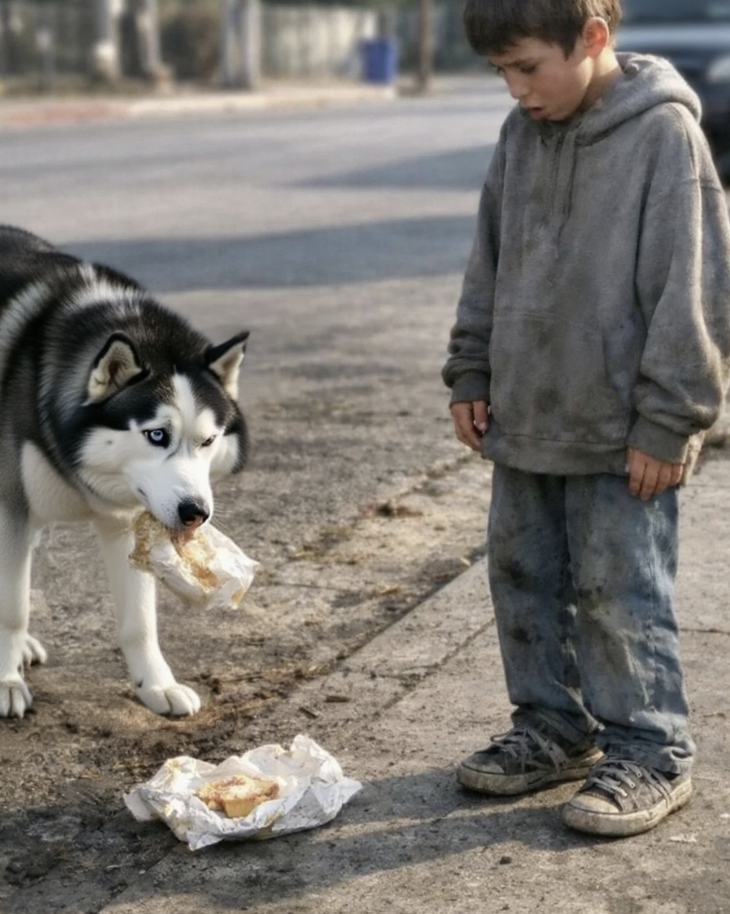
I took the sandwich—not the whole bag, just the wax-paper-wrapped sandwich—and carried it gently, the way I used to carry equipment I was trained never to damage.
I nudged the door open with my nose and padded down the driveway.
“Sarge! Get back here!” Jim shouted.
I ignored the recall. I had a mission.
I approached the oak tree. The other kids scattered, shrieking. A Husky with ice-blue eyes and a wolfish silhouette looks dangerous if you don’t know better.
But the Quiet One didn’t run.
I dropped the sandwich at his feet. The paper unfolded, revealing turkey.
I sat. I gave one low woof.
Eat.
The boy stared. Then panic hit him. He tried to push the sandwich back toward me, terrified he’d done something wrong.
Jim reached us, breathing hard. He saw the sandwich. He saw the boy’s eyes.
And then Jim stopped being angry.
“Bad dog,” Jim said gently. “You can’t just give people food off the ground.”
“I didn’t steal it,” the boy said quickly. “He just brought it.”
“I know,” Jim said, crouching with a wince. “He’s retired. Still thinks everyone needs rations.”
Jim reached into his jacket and pulled out the apple and pretzels.
“Tell you what,” he said. “Since that sandwich is ruined, could you help me out and take these? If I bring them back inside, he’ll just steal them too.”
The lie was perfect.
Not charity—a favor.
The boy nodded. Took the apple. Bit into it.
The crunch echoed like victory.
The Hollow smell faded.
After that, the mission became permanent.
Jim started making two lunches. He never handed the second one directly. That would be wrong. Instead, he “forgot” it on the low brick wall near the mailbox.
I would sit beside it and whine until the boy noticed.
“Oh no,” Jim would say from the porch. “Extra again. Want it before the raccoons do?”
“Yeah. Thanks, Mister.”
We did this for six months. The boy grew. He laughed. He stood straighter. The Hollow vanished.
On the last day of school, he didn’t board the bus. He walked up the driveway holding folded construction paper.
“This is for Sarge,” he said. “And you.”
He ran before things got awkward.
Jim opened it. A crayon drawing of a big-eared dog and a grumpy man beside a brown paper bag.
Under it, messy letters read:
The Anti-Hunger Squad
Jim wiped his eyes.
“We did good,” he said.
I already knew. The air had changed. It smelled like hope.
I’m old now. My watch is ending.
And I’ve learned the most dangerous thing isn’t a bomb or a gun.
It’s indifference.
If you see someone standing in the hollow, don’t just look away.
Break protocol.
Sometimes all it takes is a Husky with a good nose
and a turkey sandwich wrapped in wax paper.