5:15 on Elm Street
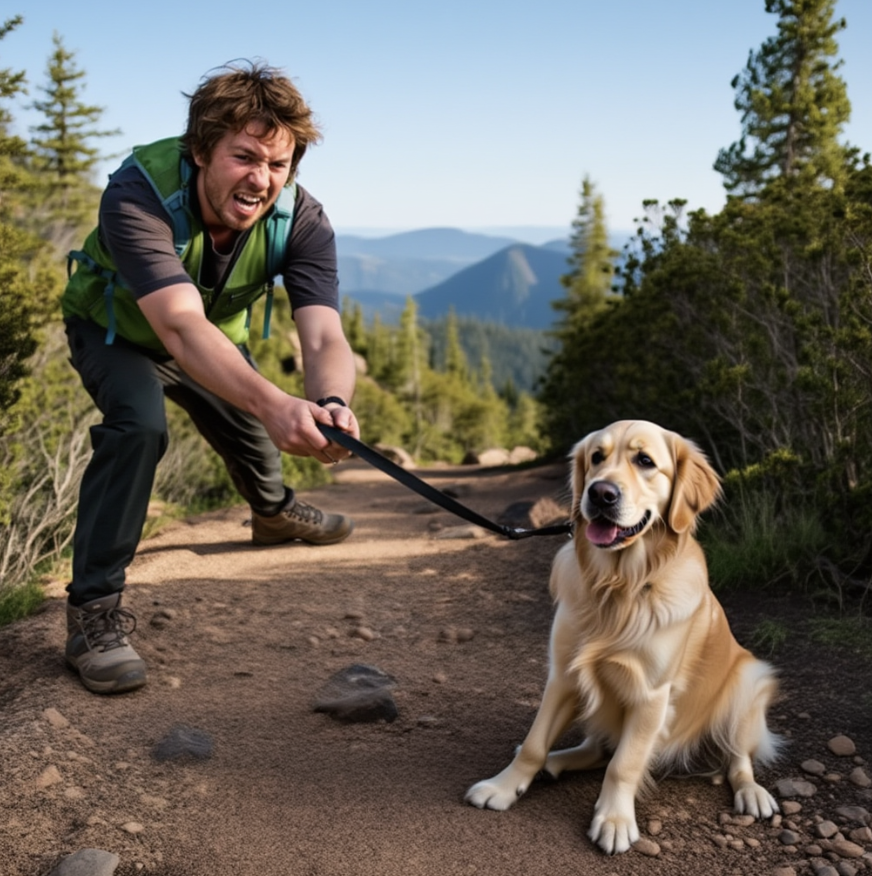
The most irritating minute of my day was always 5:15 PM—the exact moment my Golden Retriever decided to lock his legs in front of the neighborhood villain’s house and refuse to move a single inch.
My name is Leo, and my life is measured in notifications. I’m a freelance graphic designer, which is just a polite way of saying I never stop working and mildly panic if the Wi-Fi hesitates. Walking my dog was supposed to be an efficiency break: step outside, do the business, get back to the screen.
But Barnaby did not believe in efficiency.
He was a rescue, pure Golden Retriever but assembled by time—white creeping into his muzzle, joints that complained on cold days, lungs that whistled when he got excited. He moved slowly, deliberately, and with the unshakable stubbornness of something that had already learned which moments mattered.
Every evening we walked down Elm Street.
And every evening, at exactly 5:15, Barnaby would stop in front of Number 404.
Number 404 belonged to Mr. Gable.
Mr. Gable was the kind of neighbor who looked like he’d once written an angry letter to the Homeowners Association about clouds. He sat every afternoon on a rusted metal glider, arms folded tight across a faded cardigan no matter the weather, glaring at the street like it had personally disappointed him.
“Keep it moving!” he’d bark. “Don’t let that dog near my hydrangeas!”
“Sorry, sir—come on, Barnaby,” I’d mutter, tugging the leash with one hand while checking Slack with the other. “He hates us. Let’s go.”
Barnaby never barked back. Never growled.
He just stood there, staring at the old man, tail giving one slow, steady thump… thump against his leg. It usually took thirty seconds of pleading and dragging to get him moving again.
I joked about it to friends. Called Mr. Gable The Gargoyle. Called Barnaby The Anarchist. I thought it was just a battle of wills.
Then came the Tuesday with the thunderstorm.
The sky was bruised purple, wind knocking trash cans down the street. I was late, shielding my phone from the rain, desperate to get Barnaby through his routine and back to a Zoom call.
We reached Number 404.
Barnaby stopped.
“Not today,” I groaned, pulling the leash. “It’s pouring.”
But Barnaby wasn’t looking at me.
He was staring at the porch.
The rusted glider was empty.
Usually, if Mr. Gable wasn’t there, Barnaby would sniff once and move on. This time, the fur along his neck lifted. He let out a low, aching whine—then barked, sharp and urgent.
“Barnaby—stop! He’s probably inside!”
Barnaby lunged.
Not away from the house—toward it.
He dragged me across the forbidden lawn, up the porch steps, and began scratching frantically at the front door, whining like something was wrong in a way words couldn’t reach.
I tried to grab his collar. That’s when I heard it.
A faint, rhythmic thump behind the door.
Like a shoe kicking wood.
My stomach dropped.
I tried the handle—locked. I pounded. “Mr. Gable?”
The thumping came again, weaker.
I didn’t think. I shoulder-checked the door. It held. I ran around the house, found a kitchen window cracked for air, hauled myself inside, and sprinted to the hallway.
Mr. Gable lay at the bottom of the stairs, gray-faced, clutching his chest. One leg twisted beneath him. His good heel kicked the floor, over and over.
“Help,” he wheezed.
I called 911.
The next hour blurred into sirens, rain, blue lights—and me standing outside holding a shaking Golden Retriever while strangers saved a man I thought I hated.
As they loaded him into the ambulance, an EMT pressed keys into my hand.
“He said to lock up,” she told me. “And… to make sure the dog’s okay.”
The house smelled like cedar and old paper. Not a dungeon—just quiet. No TV. No computer. Shelves of vinyl records. Jazz. Motown. Big Band. Photos everywhere.
On the mantel sat a black-and-white picture: a younger Mr. Gable, arm around a smiling woman, and at their feet—
A Golden Retriever. Same eyes. Same posture.
Two weeks later, Mr. Gable came home.
At 5:15 PM, Barnaby stopped again.
This time, Mr. Gable sat on the glider with a walker beside him. He didn’t yell. He just watched.
I handed him the keys. He looked at Barnaby, eyes wet.
“That dog,” he whispered. “He’s got my Buster’s spirit. I knew it the first day.”
“Is that why you yelled?” I asked.
He shook his head. “I yelled because I didn’t want to get attached. Everyone leaves. Except him.”
Barnaby stepped forward and rested his chin on the old man’s knee.
Now, at 5:15, I put my phone away.
We sit. We listen to records. We watch the street.
And I finally understand what my dog knew all along:
Sometimes, the most important thing you can do is stop—and let someone know they’re not invisible.