
📰 THE CALENDAR CRISIS: IS TENNIS DESTROYING ITS OWN STARS?
📰 THE CALENDAR CRISIS: IS TENNIS DESTROYING ITS OWN STARS?
⏰A Game That Never Stops
Tennis is the sport that never sleeps. From January’s Australian Open under the blistering Melbourne sun to December’s Davis Cup Finals, players have little time to breathe. For a star like Carlos Alcaraz, who has played nearly 80 matches this season, the relentless grind is both a badge of honor and a ticking time bomb. Unlike footballers, who enjoy pre-seasons and mid-season breaks, tennis players live on planes, hotels, and courts, fighting every week for ranking points and prize money. The ATP calendar is designed for television and global audiences, not for human bodies. And as history has shown with Nadal’s knees, Djokovic’s elbows, or Murray’s hip, the calendar always wins. The only question is how much damage it inflicts before the body breaks.
🎾Alcaraz as the Perfect Storm
Carlos Alcaraz is not just another player; he is the face of tennis’s next generation. At 22, he has already carried the sport into a new era, hailed as the heir to Nadal and Federer. But his workload has been staggering: nine finals, eight titles, and countless hours spent on court across multiple continents. The recent ankle scare in Tokyo was more than just bad luck — it was a warning siren. He is being pulled in every direction: fans want him on court, sponsors want him on billboards, and the ATP wants him in every tournament to sell tickets. He is a marketing machine, but even machines need maintenance. When Alcaraz limped off court last week, it wasn’t just his ankle; it was the weight of an entire sport resting on him.

💥The Grind of Endless Travel
Consider this: Alcaraz finished in Tokyo on Sunday, and by Tuesday, he was expected to fly to Shanghai, adjust to a new time zone, new conditions, and be ready to compete. From Asia, the caravan heads to Europe for indoor hardcourt season, then to the World Tour Finals, and finally to Davis Cup. There is simply no downtime. Physiotherapists warn that young players are far more at risk because their bodies are still adapting to the intensity of the professional tour. Even Nadal admitted that one of his biggest regrets was not pacing himself better in his early 20s. The problem is systemic: the ATP calendar demands constant presence, and absence means losing ground in rankings and sponsorships. For players like Alcaraz, “rest” has become a luxury he cannot afford.
🏆The Weight of Expectation
Every era has its gladiator, and right now, Alcaraz is expected to be the gladiator who never falls. Media outlets hail him as unstoppable, fans want him at every Masters and Slam, and the pressure to live up to his billing as the new king is relentless. But greatness comes with expectation, and expectation carries its own form of injury. When Federer skipped parts of the season to prolong his career, he was already an established icon. Alcaraz doesn’t have that cushion; he is still building his legacy, still proving himself. That forces him into a vicious cycle: play more to stay relevant, but risk burning out before his prime. And for tennis, losing him to injury now would be catastrophic, not just for one season, but for the sport’s entire narrative.
🔥ATP’s Ruthless Demands
The ATP Tour, for all its glamour, is merciless. Players are treated as global assets, shuffled from continent to continent to satisfy sponsors and television networks. Unlike team sports, there is no rotation, no substitution, no break when form dips or fatigue sets in. You either play or you disappear from relevance. Critics argue that the ATP has failed to protect its stars, chasing short-term profit at the cost of long-term sustainability. Federer, Nadal, and Djokovic survived because they were extraordinary outliers — but even they paid the price with multiple surgeries. For someone like Alcaraz, who is still learning how to pace himself, the risk is multiplied. The question is no longer whether the calendar is brutal, but whether it is fundamentally broken.
🕰️Lessons From the Past
History is littered with cautionary tales. Boris Becker, a teenage prodigy, won Wimbledon at 17 but was physically and emotionally spent by his late 20s. Lleyton Hewitt rose to World No.1 before 21, only to see his body collapse under the strain of endless seasons. Rafael Nadal, perhaps the greatest fighter tennis has ever seen, openly admits his career has been shortened by the tour’s demands. Andy Murray’s hip became a symbol of sacrifice. The pattern is clear: young stars pushed to their limits often flame out early. Unless Alcaraz learns to manage his schedule — or unless the sport reforms itself — he risks becoming another tragic chapter in tennis’s cycle of brilliance and breakdown.
🌍Globalization at a Cost
Tennis’s global appeal is its greatest strength and its greatest weakness. From South America to Asia, the tour sells itself as a sport without borders. But that means players like Alcaraz are constantly subjected to jet lag, climate changes, and cultural shifts — not once or twice, but weekly. Sports science shows that constant long-haul flights severely affect recovery, immune systems, and injury risk. Fans may see only the two hours on court, but behind the scenes, it’s sleepless nights, strange food, and endless media duties. By the time players step onto court, they are already fighting fatigue. For a young superstar under constant spotlight, that cocktail is dangerous. Globalization may make tennis profitable, but it could also make its stars disposable.
⚡The Djokovic-Alcaraz Parallel
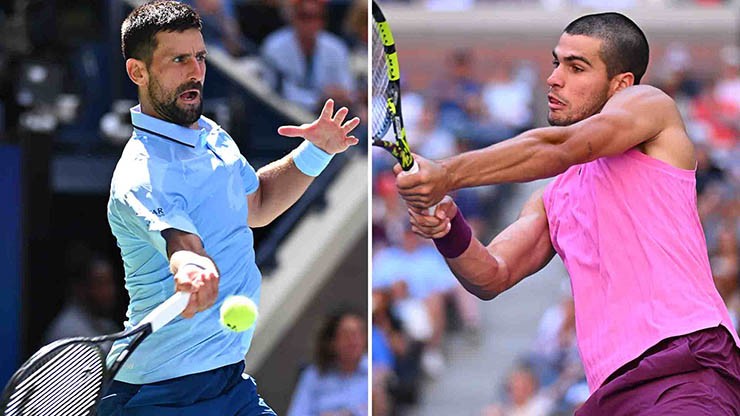
Novak Djokovic is the ultimate example of pacing a career. Now in his late 30s, he chooses his schedule carefully, skipping events to preserve himself for Grand Slams. It is a luxury Alcaraz does not yet have. The rivalry between them has been billed as the defining story of this era, but what happens if Alcaraz is forced to miss key events? Djokovic’s dominance has been built on iron discipline and meticulous preparation. Alcaraz’s brilliance has been built on fearlessness and constant appearances. One is sustainable, the other is risky. Already, their rivalry is being reshaped not by what happens on court, but by what happens off it — by who can endure the marathon calendar longer. In this sense, the real opponent for both may not be each other, but time itself.
💸The Money Machine
Why does the ATP refuse to shorten the season? The answer is simple: money. Every extra tournament means revenue from broadcasters, ticket sales, and sponsorships. Asia, in particular, has become a goldmine for tennis, with cities like Shanghai, Beijing, and Tokyo paying enormous sums to host events. Players may complain about the toll, but few turn down appearance fees worth millions. The sport has created a system where stars are both indispensable and replaceable: indispensable because fans demand them, replaceable because the calendar will roll on without them. It is a cruel irony that the very success of players like Alcaraz drives the machine that could eventually destroy them.
🏟️Fans Feel the Cost Too
It is not only players who suffer — fans are paying the price as well. Supporters buy tickets months in advance, often traveling across the world to see their idols, only to learn days before that their hero has withdrawn. The disappointment in Shanghai this week was palpable. Families had saved for months, fans queued for hours, and all for nothing. This is not the fault of the players, but of a system that pushes them beyond their limits, making withdrawals inevitable. In the end, everyone loses: the player risks his health, the fans lose their moment, and the sport loses credibility. Yet, somehow, the cycle continues — because no one wants to be the first to say “enough.”
🧠Mental Fatigue, the Invisible Injury
Physical injuries dominate headlines, but mental exhaustion may be an even bigger threat. The pressure of expectation, combined with the constant grind, wears players down mentally. Alcaraz has admitted in the past that he struggled with confidence and emotional balance earlier this year. Competing week after week, under constant scrutiny, drains more than muscles — it drains spirit. Tennis is unique in its solitude: no teammates to share the burden, no coach on the sidelines during play. You face not just your opponent, but yourself. For young players like Alcaraz, who carry the hopes of nations and the burden of being “the next big thing,” the mental battle may be as dangerous as any twisted ankle.
🚑The Price of Playing Through Pain
One of the sport’s great myths is that champions must always play through pain. Fans celebrate Nadal for winning with a broken foot, Murray for limping through Wimbledon, or Djokovic for playing with a torn muscle. But every time a star plays hurt, the message to younger players is clear: pain is weakness, and weakness is unacceptable. Alcaraz’s decision to cut off his bandages in Tokyo looked heroic, but was it reckless? Did that performance cost him Shanghai? The culture of glorifying pain ensures players push themselves further than they should, and the cycle of injury continues. Unless tennis changes its attitude toward rest and recovery, the next generation may break even faster than the last.
🏋️The Science of Recovery Ignored
Sports science has evolved dramatically in recent years. Nutritionists, physiologists, and psychologists all stress the importance of recovery — sleep, diet, and downtime are as critical as training itself. Yet the ATP calendar leaves little space for these essentials. A player may finish a match at midnight, travel the next day, and be expected to compete again within 48 hours. Even the best medical teams cannot compensate for systemic exhaustion. Experts argue that if tennis truly embraced sports science, the season would be shortened, or mandatory rest periods would be introduced. But until revenue stops dictating reality, science will always take a backseat to spectacle.
🧩What the Future Holds
The future of tennis hangs in a fragile balance. Alcaraz represents hope, excitement, and the promise of another golden era. But if his body begins to break down at 22, what does that say about the sport itself? Already, promising stars like Alexander Zverev, Dominic Thiem, and Bianca Andreescu have seen their careers derailed by injuries before they could fulfill their potential. Without reform, tennis risks losing an entire generation of players too soon. Fans want longevity, rivalries, and greatness — but those things cannot exist without protection. The sport must decide: does it value stars enough to save them, or will it continue to grind them into early retirement?
🌌 The Clock Is Ticking
Carlos Alcaraz is resting now, but the bigger picture remains unresolved. The calendar does not stop, the tournaments march on, and the machine keeps running. Tennis has created a paradox: its stars are its greatest asset, yet it treats them as disposable. Alcaraz may recover, may rise again, may even dominate for the next decade. But the warning has been sounded. Unless tennis reforms itself, the cycle of overwork and breakdown will continue. The clock is ticking — not just on Alcaraz’s body, but on the very future of the sport. And when the clock runs out, it won’t be just one ankle at risk, but the soul of tennis itself.