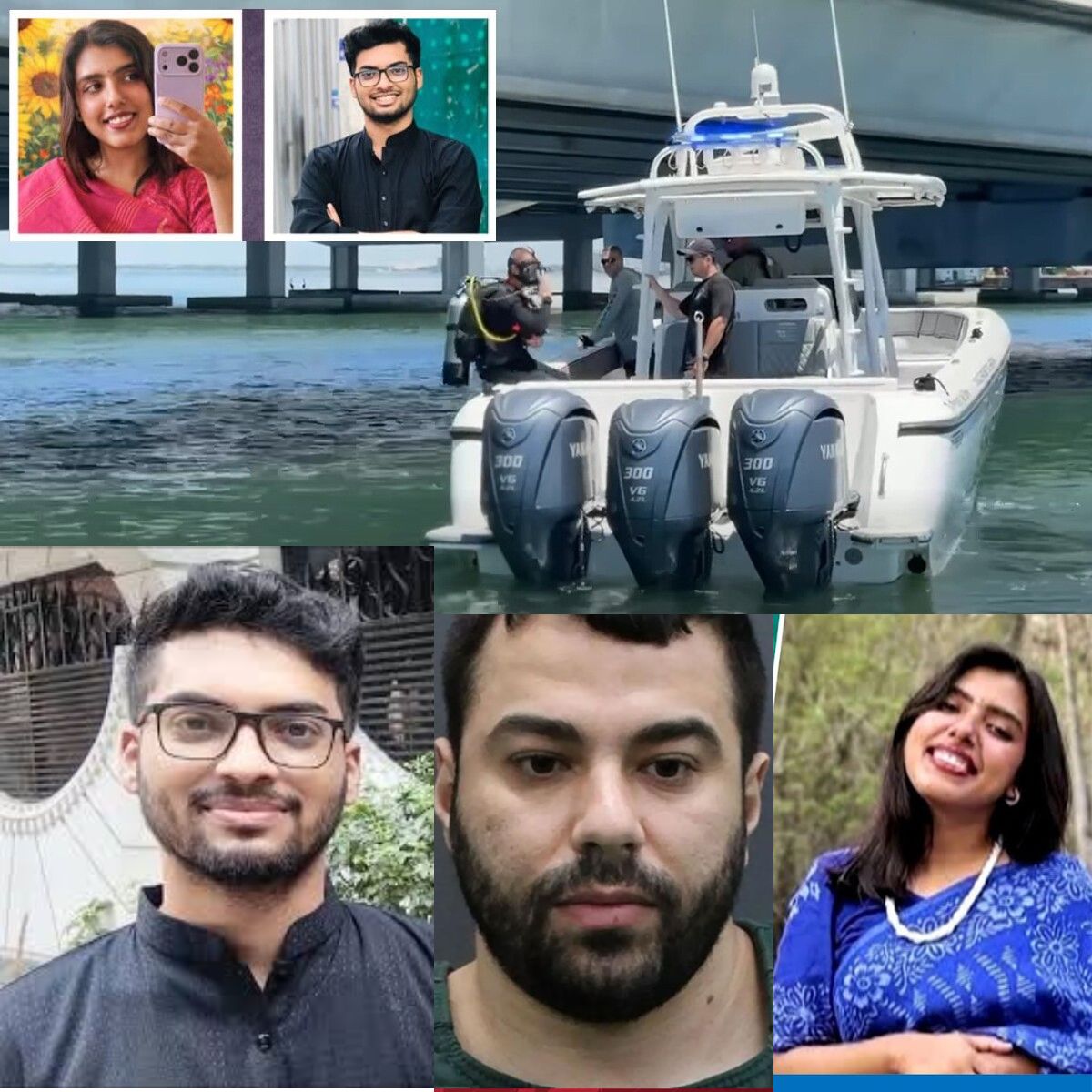
Grim discovery in Tampa Bay waters: Second set of human remains recovered near Howard Frankland Bridge as search continues for missing USF doctoral student Nahida Bristy – roommate Hisham Abugharbieh charged with double murder
In a case that has sent shockwaves through the University of South Florida campus and the close-knit Bangladeshi student community in Tampa, authorities have recovered yet another set of human remains from the murky waters of Tampa Bay — this time in St. Petersburg — as the desperate search for missing 27-year-old doctoral student Nahida Bristy continues.
The latest grim find came on Sunday evening near Interstate 275 and 4th Street North, on the Pinellas County side of the iconic Howard Frankland Bridge, the very area where the body of Bristy’s fellow student and apparent romantic interest, Zamil Limon, was discovered just days earlier.
Hillsborough County Sheriff’s Office deputies, working alongside Pinellas County teams, pulled the unidentified remains from the waterway late on April 26. They have now been turned over to the Pinellas County Medical Examiner’s Office for autopsy and identification. At the time of writing, it remains unclear whether these remains belong to the still-missing Nahida Bristy — or if they are connected to the horrifying double-murder investigation that has already claimed one young life.
Zamil Limon’s remains were recovered on Friday, April 24, from the Howard Frankland Bridge, found inside heavy-duty utility trash bags. The 27-year-old Bangladeshi national had been stabbed multiple times, with his wrists and ankles bound, according to chilling details emerging from court documents.
Just hours after that discovery, Limon’s roommate, 26-year-old Hisham Abugharbieh, was taken into custody following a dramatic standoff at his home. He now faces two counts of first-degree premeditated murder with a weapon in the deaths of both Limon and Bristy, along with a slew of additional charges including tampering with evidence, unlawfully moving a dead body, failure to report a death, false imprisonment, and battery. He is being held without bond.
USF President Moez Limayem moved quickly to reassure the campus community, stressing that the killings took place off campus and that Abugharbieh — who is not a current student or employee of the university — acted alone. “There is no ongoing threat to the university community,” he said.
Yet for the families of the two promising young scholars thousands of miles away in Bangladesh, and for their friends in Florida, the nightmare is far from over.
Promising futures shattered: Who were Nahida Bristy and Zamil Limon?
Both victims were ambitious 27-year-olds from Bangladesh pursuing doctoral degrees at the University of South Florida on student visas. They were described as bright, hardworking, and close — friends who had developed romantic feelings and were even considering marriage, according to Limon’s brother.
Nahida Bristy was a doctoral student in chemical engineering. She had already earned a master’s from the prestigious Bangladesh University of Engineering and Technology and a bachelor’s in applied chemistry and chemical engineering. Those who knew her spoke of a dedicated scholar who balanced rigorous lab work with a warm personality. Her last known sighting was on the morning of April 16 at the Natural and Environmental Sciences building on the USF Tampa campus.
Zamil Limon was also 27 and deeply invested in his studies. The pair were last seen together on campus that same day. Friends reported they had planned to go shopping or spend time together. By April 17, when they could not be reached, a family friend filed a missing persons report that would soon spiral into one of the most disturbing cases in recent Tampa Bay history.
Their disappearance triggered an intense multi-agency search involving dive teams, helicopters, and ground patrols, focusing heavily on the areas around the Howard Frankland Bridge, which spans Tampa Bay and connects Hillsborough and Pinellas counties.
The arrest and mounting evidence against Hisham Abugharbieh
Hisham Abugharbieh, 26, shared an apartment with Zamil Limon and at least one other roommate. Court documents paint a deeply disturbing picture of the days leading up to and following the alleged crimes.
Investigators discovered a large amount of blood inside the apartment — trails leading from the entryway through the kitchen and into Abugharbieh’s bedroom. Items belonging to Limon, including his student ID, credit cards, and eyeglasses, were later recovered from a dumpster at the complex, along with a gray shirt and black floor mat that tested positive for blood linked to both victims.
Perhaps most chilling of all: prosecutors allege that in the days before the students vanished, Abugharbieh turned to ChatGPT with a series of incriminating questions. He reportedly asked the AI chatbot what would happen if a human body was placed in a black garbage bag and thrown in a dumpster, and followed up with “How would they find out?” He also inquired about changing a car’s VIN number and keeping an unlicensed gun at home.
Abugharbieh’s story to detectives allegedly shifted multiple times. He initially claimed he had not seen the couple on April 16. When confronted with evidence that his car was captured on camera near Clearwater Beach — an area where Limon’s phone had pinged — he changed his account, claiming he had simply given them a ride.
A CVS receipt from that day listed trash bags, Lysol wipes, and Febreze. Another roommate reportedly saw Abugharbieh using a rolling cart to move cardboard boxes to the complex dumpster late on April 16 and into the early hours of April 17.
When arrested on Friday, April 24, following an unrelated domestic violence call, Abugharbieh barricaded himself inside his family’s home before surrendering. He was initially taken into custody wearing only a towel.
On Saturday, additional charges of premeditated first-degree murder were filed in connection with both deaths. A judge ordered him held without bond, citing the brutal nature of the alleged crimes and the danger he would pose to the community if released.
The second set of remains: Hope and dread in equal measure
The recovery of additional human remains on Sunday evening has only deepened the anguish surrounding the case. Found in the water near I-275 and 4th Street North — just a short distance from where Limon’s body was located on the bridge — the remains are currently with the Pinellas County Medical Examiner. Positive identification could take days.
While authorities have been careful not to confirm any link, the proximity to the previous discovery site and the ongoing search for Bristy have led many to fear the worst. Divers and search teams had been scouring the bay and surrounding waterways for clues in the days after Limon’s body was found.
For Bristy’s family back in Bangladesh, the wait has been excruciating. Her father has made emotional pleas for information, telling reporters he simply wants to see his daughter’s face one last time. Her brother has reportedly been informed by U.S. authorities that investigators believe she is dead, based on the volume of blood evidence found in the apartment.
A community in mourning
The University of South Florida has offered counseling services and support to students and faculty reeling from the loss. Many international students from Bangladesh and other South Asian countries have expressed feelings of shock and vulnerability, wondering how such violence could touch two of their most promising peers.
Friends described Bristy and Limon as kind, focused, and full of potential. One acquaintance said the pair had spoken excitedly about their research and future plans together. “They were building something beautiful,” the friend told local media.
The broader Tampa Bay Bangladeshi community has rallied, organizing prayer vigils and offering support to the victims’ families overseas. Questions are already being raised about safety for international students living off-campus and the adequacy of support systems for those far from home.
What drove the alleged killings? Motive still unclear
As the investigation continues, authorities have not publicly detailed a clear motive. Court filings suggest the attacks may have been premeditated, but the exact trigger — whether a personal dispute, jealousy, financial issues, or something more sinister — remains under wraps as detectives piece together digital evidence, phone records, and forensic results.
Abugharbieh’s defense has yet to make substantial public comments, with his court-appointed attorneys emphasizing his right to a fair trial. He is due back in court for further proceedings in the coming days.
Hillsborough County Sheriff Chad Chronister described the case as “deeply disturbing,” praising his detectives for working “tirelessly” to uncover the truth while expressing condolences to the victims’ families.
The wider implications
This tragedy has once again thrust the spotlight on the sometimes hidden pressures faced by international graduate students in the United States — the isolation of being far from family, the intense academic demands, and the challenges of navigating life in a new country.
It also raises uncomfortable questions about roommate dynamics, mental health support on campus, and how seemingly ordinary apartment conflicts can allegedly escalate into unimaginable violence.
As forensic experts work around the clock to identify the latest remains, the families of Nahida Bristy and Zamil Limon continue to grieve from afar. For Bristy’s loved ones, every passing hour without confirmation brings a torturous mix of hope and despair.
The University of South Florida has reiterated that the campus itself remains safe, with the incidents occurring off-site. Yet for many students, the sense of security has been shattered.
Authorities continue to urge anyone with information about Nahida Bristy’s whereabouts or the events of April 16 to contact the Hillsborough County Sheriff’s Office immediately.
As this harrowing story develops, the focus remains on bringing closure to two devastated families and ensuring justice for two young lives full of promise that were allegedly cut short in the most brutal fashion.
The discovery of a second set of remains has only intensified the urgency. Whether these belong to Nahida Bristy or represent another tragic chapter, the people of Tampa Bay — and the global academic community — are watching closely.
Our thoughts and prayers are with the families of Nahida Bristy and Zamil Limon as they endure this unimaginable ordeal. May they find strength, answers, and eventually peace.