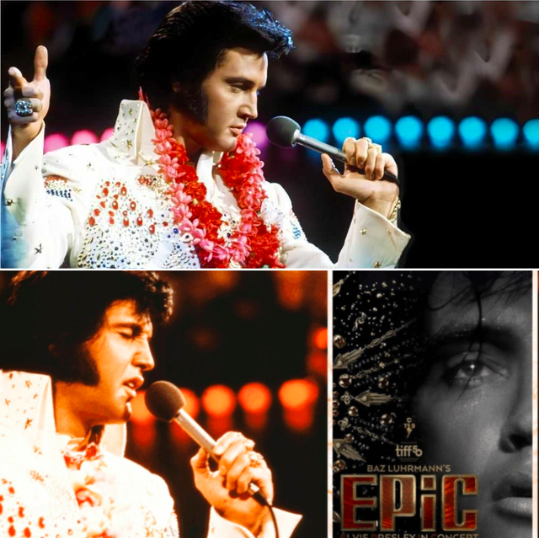
🔥 EPiC: The Return of the King — How Baz Luhrmann’s New Documentary Is Bringing Elvis Presley Back to the World Stage
In 1969, if you were lucky enough to be in Las Vegas — or bold enough to travel there — you could see Elvis Presley blaze across the stage for just $15. It was a moment in music history that felt mythic even as it happened: Elvis, fresh from his ‘68 Comeback Special, reclaiming his throne in a 29-show residency that drew more than 100,000 people and helped redefine what a Vegas performance could be.
More than five decades later, in a world that has changed culturally, politically, and technologically, that magic is returning — not as nostalgia, but as revelation.
In 2026, filmmaker Baz Luhrmann will release EPiC: Elvis Presley in Concert, a project already being hailed as the defining Elvis film event of the century. Backed by distributors Universal Pictures and NEON, and powered by 59 hours of long-lost footage, the documentary promises to be nothing short of a resurrection: Elvis not as an icon frozen in time, but as a living, breathing artist at the height of his power.
This time, audiences won’t just watch history — they’ll enter it.
A Documentary 50 Years in the Making
Baz Luhrmann had already reshaped the cultural image of Elvis with his 2022 feature film Elvis, but what he found during that production would eventually change everything.
For years, rumors circulated in the Elvis community about lost film reels from the Vegas era — reels containing candid backstage moments, rehearsals, early residency footage, and fragments of concerts never seen by the public. What no one knew was whether they truly existed, or whether they had disintegrated in storage decades ago.
Then, deep beneath Kansas, in a set of industrial salt mines used for archival preservation, Luhrmann found the treasure.
“We found over 59 hours of footage. Footage that had been sealed away for decades,” he later said.
Some of it was pristine 16mm film. Some was 8mm home-style footage stored in the Graceland archives. Some had sound; much of it did not. But all of it was intimate, electric, and raw — the closest anyone has come to experiencing Elvis Presley unfiltered.
And suddenly, the idea for EPiC was born.
The Trailer That Sent Fans Into a Frenzy
When the first trailer for EPiC dropped, Elvis fans and cinephiles alike knew immediately that this was not a standard documentary.
The trailer opens in silence.
Then — the soft swell of Richard Strauss’ Also sprach Zarathustra, the same opening theme Elvis used onstage.
We see him backstage, one hand gripping a microphone, foot tapping with nervous energy. Not the Elvis of tabloid mythology, but the Elvis of flesh and bone — focused, vulnerable, human.
A title card appears:
“In 1969, Elvis returned to the stage… to begin a legendary residency in Las Vegas.”
Then the screen erupts into life. Elvis warming up his voice. Elvis laughing with musicians. Elvis pacing. Elvis praying. Elvis performing with an intensity that almost scorches the lens.
For a moment, time folds.
This is Elvis as audiences have never seen him — not repackaged, not dramatized, but real.
The trailer goes on to deliver its most shocking revelation:
“During the production of Baz Luhrmann’s Elvis, the footage was found.”
For fans who’ve spent decades believing nothing new could ever surface, the discovery feels like a miracle.
‘This Is More Than a Documentary’
As Elvis’ voice comes in — not through interviews with others, but through his own recovered audio — the tone shifts. This isn’t a biography told through the usual third-party recollections. This isn’t a “talking-head” film crowded with industry experts and historians.
Instead, EPiC becomes something rarer:
Elvis tells his own story. In his own words.
“We found audio of Elvis talking about his life,” Luhrmann explained. “Not interviews for the press. Not performance clips. But Elvis speaking privately, honestly — maybe more honestly than ever before.”
The footage and audio don’t simply complement each other. They complete each other.
Luhrmann describes the film as a “tone poem” — a sensory story told through emotion, rhythm, image, and the most powerful parts of Elvis’ musical legacy.
The film is not designed to lecture. It is designed to immerse.
To make you feel.
A Global Release Worthy of Royalty
NEON and Universal Pictures have announced an ambitious worldwide distribution plan:
-
February 20, 2026: Exclusive IMAX premiere
-
February 27, 2026: Worldwide theatrical release
For Luhrmann, this global rollout fulfills a dream Elvis once spoke of but never realized.
At a 1972 press conference, Elvis famously said:
“I’ve never been out of this country, except in the service.”
He wanted to tour the world. He wanted fans everywhere to see him live. But the opportunity never came.
Now, more than 50 years after his death, EPiC will take Elvis where he always wanted to go — across the globe.
Luhrmann said it best:
“We get to fulfill a dream Elvis never got to fulfill.”
A Cinematic Resurrection
The newly uncovered reels contain everything fans hoped existed — and countless moments they never imagined:
-
Footage from Elvis’ Vegas shows
-
Rare rehearsal sessions
-
Restored 16mm film from Elvis on Tour
-
Intimate 8mm recordings stored at Graceland
-
Audio tapes of Elvis reflecting on his career
Warner Bros. handled the painstaking process of synching audio to silent footage — a technical challenge that took nearly two years.
But the effort shows.
Elvis doesn’t just appear on the screen. He lives there.
This is not Elvis the legend. This is Elvis the artist.
The Premiere That Left Toronto Speechless
In September 2025, the film premiered at the Toronto International Film Festival, where Baz Luhrmann electrified the audience with behind-the-scenes stories.
He joked:
“The film is 37 hours long.”
The audience laughed — until Jonathan Redmond, editor and producer, corrected him:
“Close to 59 hours, actually.”
The crowd fell quiet.
For Elvis fans, this discovery is on the level of finding lost works of Van Gogh or unreleased masters from The Beatles.
For the first time, the world may finally see Elvis Presley not as a distant cultural icon, but as a complete human being — brilliant, intense, flawed, vulnerable, and magnificently alive.
Why EPiC Matters — Not Just as a Film, but as a Cultural Reckoning
The legend of Elvis Presley has always been larger than life. But EPiC doesn’t aim to enlarge him further. Instead, it seeks to restore him — to show the man behind the myth, the performer behind the persona, the human behind the history.
It brings back the Elvis who:
-
Worked relentlessly
-
Pushed through insecurity
-
Cared deeply about his music
-
Transformed American culture
-
Fought his demons silently
-
Loved the stage with every atom in his body
For younger generations, this will be their first real encounter with Elvis.
For longtime fans, it will be the closest thing to seeing him live again.
For the world, it will cement — once and for all — why Elvis Presley remains one of the most magnetic figures in entertainment history.
A New Chapter Begins
With IMAX screenings, global distribution, and never-before-seen footage, EPiC is set to become not just a documentary, but an event — a cultural revival that brings Elvis to millions who never had the chance to witness the phenomenon firsthand.
As Luhrmann himself said:
“I cannot wait to go on the road with EPiC.”
This time, Elvis goes with him.
And the world is ready.