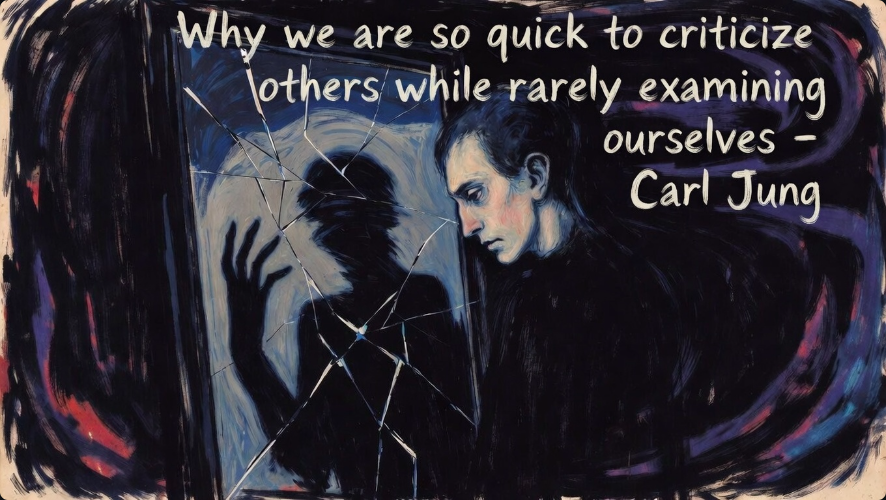
🗣 Why we’re so quick to criticize others while rarely examining ourselves – Carl Jung
In the quiet unfolding of a life well-lived, one often encounters moments where the world seems to echo back the unspoken murmurs of the soul. Most people, as the years accumulate like layers of sediment in a ancient riverbed, move through their days without pausing to interrogate the convictions that have settled within them—beliefs inherited from the clamor of youth, shaped by the winds of circumstance, and hardened by the passage of time. These beliefs, unexamined, form the invisible architecture of our perceptions, guiding our judgments with a subtlety that belies their power. It was Carl Jung, that profound explorer of the human depths, who illuminated a mechanism within the psyche that accounts for this peculiar asymmetry: our readiness to cast a critical eye upon others, while averting that same gaze from ourselves. This mechanism, known as projection, reveals an unsettling truth about the human condition—one that, once grasped, alters forever our understanding of conflict, of argument, and indeed of the self. It invites us, in the twilight of our years, not to seek entertainment in fleeting distractions, but to turn inward, to contemplate the mirrors we unwittingly hold up to the world.
Jung’s vision of the psyche was not a simple map of conscious thoughts and forgotten memories, but a vast, dynamic landscape where the known and the unknown intermingle like roots entwined beneath the soil. At its core lies the ego, that center of awareness we identify as “I”—the part of us that navigates the demands of daily existence, forming opinions, making choices, and upholding the persona we present to society. Yet beyond this illuminated foreground stretches the unconscious, a realm of immense depth and shadow, harboring elements of our being that have been relegated to obscurity. Among these is what Jung termed the shadow archetype, a repository of traits, impulses, and desires that the ego deems unacceptable, incompatible with the self-image we have cultivated over decades. The shadow is not merely a collection of flaws or vices; it encompasses all that we have disowned—perhaps the aggression we suppressed in pursuit of harmony, the vulnerability we armored against in times of hardship, or the unacknowledged yearnings that simmered beneath the surface of dutiful lives. It is, in essence, the “other” within us, the counterpart to our conscious identity, born from the inevitable fragmentation that occurs as we adapt to the world’s expectations.
Projection emerges from this inner division as a natural, albeit unconscious, process. It is the psyche’s way of externalizing what it cannot yet integrate internally. As Jung observed, “Projection is one of the commonest psychic phenomena…Everything that is unconscious in ourselves we discover in our neighbour, and we treat him accordingly.” In this act, we attribute to others the very qualities we harbor within, but refuse to recognize. It is not a deliberate deception, but a spontaneous overflow from the unconscious, where the shadow seeks expression without the ego’s consent. Freud, Jung’s predecessor, viewed projection as a defense mechanism, a shield against the anxiety provoked by confronting one’s own shortcomings. Jung, however, expanded this understanding, emphasizing its necessity in psychological development. He saw projection not merely as evasion, but as a bridge—a means by which the unconscious communicates its contents, projecting them outward like shadows cast by an unseen light, allowing us, if we are attentive, to glimpse what lies hidden.
Consider, for a moment, the weight of this in the context of judgment. When we encounter another whose actions stir indignation within us—perhaps a neighbor’s perceived selfishness, or a public figure’s apparent hypocrisy—we are often quick to condemn. Yet Jung’s insight compels us to pause: what if this judgment is less about the other and more a reflection of our own unacknowledged self? The shadow, laden with those aspects we have banished from awareness, finds its voice in these moments of critique. We see in others the greed we dare not admit in our own quiet ambitions, the weakness we have long denied in our stoic endurance. This is the unsettling core of projection: it distorts our perception, turning the external world into a canvas upon which our inner conflicts are painted. As Jung articulated, “Projections change the world into the replica of one’s own unknown face.” In this replica, we engage not with reality, but with illusions born of our disowned parts, fostering misunderstandings that ripple through our interactions.
The roots of this mechanism lie deep in the psyche’s structure. From early life, as we forge our identity amid familial and societal pressures, certain traits are deemed unworthy. The child who learns to suppress anger to maintain peace may grow into an adult who projects that same anger onto others, perceiving them as volatile while maintaining an illusion of inner calm. Jung linked this closely to the shadow archetype, noting that the unacceptable parts of the personality—those repressed into the unconscious—are particularly prone to projection. The shadow, he explained, carries what is treacherous and subversive within us, the unethical or immoral that we hide, only to encounter it in the form of judgments cast outward. This process is not static; it is dynamic, often reciprocal. As Jung observed, “All projections provoke counter-projection when the object is unconscious of the quality projected upon it by the subject.” Thus, in arguments—those heated exchanges where beliefs clash—we do not merely debate ideas; we enact a dance of shadows, each projecting onto the other what remains unresolved within.
Reflect upon the arguments that have marked your own journey. In the heat of disagreement, whether over matters trivial or profound, there often lurks a sense of righteousness, a conviction that the other’s flaw is evident while our own position is unassailable. Jung’s lens reveals this as projection at work: the beliefs we hold unexamined become the ammunition we fire at others, blind to how they mirror our own uncertainties. We judge the other’s rigidity, perhaps, because it echoes our own unyielding convictions; we decry their blindness, unaware that it stems from our refusal to see inward. This asymmetry—judging outward while sparing the self—stems from the psyche’s protective instinct. To turn scrutiny inward requires confronting the shadow, that repository of all we have deemed unworthy, and such confrontation stirs the depths, evoking the anxiety of self-revelation. Yet it is precisely this avoidance that perpetuates conflict, for as Jung warned, the projection of the shadow onto others is the root of almost all disputes. In families, in communities, even in the broader tapestry of society, arguments escalate not from facts alone, but from the unseen projections that infuse them with emotional charge.
In relationships, this mechanism assumes a particularly intimate form. Jung viewed human connections as arenas where the unconscious plays out its dramas, often through projection. We project not only our shadows but also our ideals—the anima or animus, those archetypal images of the opposite sex that reside in the unconscious—onto partners, friends, or even strangers. In the early glow of affection, we may see in another the embodiment of virtues we have disowned, creating an illusion of completeness. Yet as familiarity deepens, the shadow emerges: irritations arise, judgments form, and we attribute to the other the flaws we cannot face in ourselves. A partner’s perceived laziness might reflect our own unacknowledged inertia; their emotional distance, our fear of vulnerability. Jung emphasized that such projections isolate us, replacing genuine relation with illusion. The effect is a vicious circle: the more we project, the greater the alienation, as the other becomes a vessel for our unresolved inner world rather than a true companion.
This relational dynamic underscores the broader implications of projection. On a collective scale, Jung suggested that widespread projection could lead to societal strife, even war, as groups project their shadows onto perceived enemies. In personal spheres, it manifests in the quiet erosions of trust, the arguments that recur like echoes in a cavern, each time revealing not new insights but old, unintegrated wounds. The unsettling truth Jung uncovered is that our ease in judging others stems from this very mechanism: it spares us the discomfort of self-examination, allowing us to externalize what demands internal reckoning. We move through life, as the hook suggests, without questioning our beliefs, because to do so would mean facing the shadow—the part of us that holds the keys to our wholeness but also the pain of our fragmentation.
Yet Jung did not leave us in this shadowed valley without a path forward. He spoke of the necessity of withdrawing projections, of integrating the shadow into conscious awareness. This integration is not a conquest, but a reconciliation—a slow, deliberate process of acknowledging what has been disowned. It begins with recognition: noticing the patterns in our judgments, the emotional intensity that signals projection at play. As we withdraw these projections, like retrieving threads from a woven tapestry, we reclaim the energy bound in illusion, redirecting it toward self-understanding. Jung described this as the work of individuation, the journey toward wholeness where the ego and the shadow coalesce, reducing the compulsion to project. In this union, judgments soften; arguments transform from battlegrounds into opportunities for mutual revelation.
For those in the later seasons of life, this invitation to integration resonates with the accumulated wisdom of years. We have witnessed the cycles of human folly, the recurring patterns in our own stories and those of others. To integrate the shadow is to honor this wisdom, to turn the gaze inward not with harshness, but with the gentle curiosity of one who has learned that true peace lies in acceptance. It means reflecting on past arguments—not to assign blame, but to discern the projections that fueled them. What beliefs, unexamined, did I defend so fiercely? What shadows did I cast upon the other, mistaking them for their essence? Such contemplation fosters a profound humility, a recognition that we are all vessels of the same psychic forces, projecting and receiving in an eternal interplay.
The benefits of this integration extend beyond the individual. As Jung noted, “The best political, social, and spiritual work we can do is to withdraw the projection of our own shadow onto others.” In withdrawing, we diminish the conflicts born of misunderstanding, fostering relations grounded in authenticity rather than illusion. Arguments, once arenas of projection, become dialogues of depth, where differing beliefs are explored not as threats, but as reflections of the human mosaic. We learn to question our convictions, not out of doubt, but from a place of mature inquiry, allowing the psyche’s depths to inform our surface lives.
In the end, Jung’s mechanism—projection—unveils the psyche’s profound irony: in judging others, we reveal ourselves. To grasp this is to forever alter our view of arguments, seeing them not as clashes of egos, but as invitations to self-discovery. For the elder reader, this understanding offers not entertainment, but a mirror for introspection—a chance, in the quiet of reflection, to integrate the fragments of a lifetime, achieving a wholeness that echoes the soul’s deepest longing. As the shadows lengthen in the evening of life, may we find the courage to turn inward, embracing what we once projected, and in that embrace, discover the light within the dark.