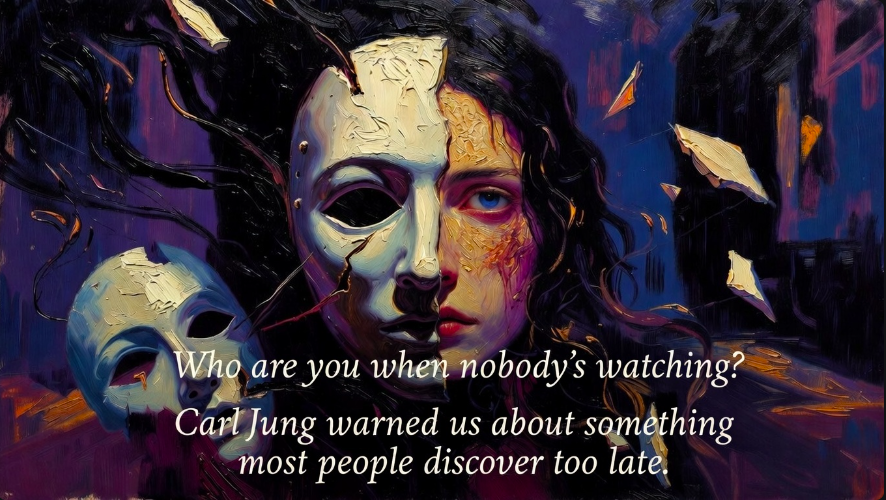
❤️ Who are you when no one is watching? Carl Jung warned that the greatest tragedy isn’t failure — it’s living a life shaped entirely by other people’s expectations.
In the quiet hours when the house falls silent and the day’s obligations have receded, one may find oneself alone with a question that has lingered through the decades: Who am I, truly, when no eyes are upon me? The face in the mirror, familiar yet strangely distant, carries the lines of years spent adapting, conforming, fulfilling roles assigned by others—parent, spouse, professional, elder in the community. These roles, necessary as they once seemed, have accumulated like sediment, covering the original contours of the self until the mask feels more natural than the face beneath it. Carl Jung, peering into the depths of the human soul over a long lifetime, regarded this as no minor misfortune but a profound tragedy: to live an entire existence shaped not by one’s inner truth but by the expectations of the world around us.
Jung did not speak of this in dramatic terms of catastrophe or sudden ruin. His observations were slower, more inexorable, drawn from the observation of countless lives and his own inner confrontations. He saw that society, with its quiet insistence on harmony and utility, rewards what is convenient and predictable. It offers approval for the well-adjusted persona—the competent provider, the agreeable companion, the reliable figure who causes no disturbance. In return, it quietly assigns identities that serve collective needs before individual ones. Parents, teachers, employers, cultural norms—all contribute to this shaping, often without malice, simply as the natural flow of things. Yet over time, the self that emerges is not one’s own but a composite, a careful construction designed to fit seamlessly into the expectations of others. The tragedy lies not in failure to achieve worldly success, but in the gradual eclipse of authenticity: one becomes a stranger to oneself, living a life that is outwardly commendable yet inwardly hollow.
Central to Jung’s understanding was the concept of the persona, that adaptive mask we wear to navigate the social world. The persona is indispensable; without it, human relations would dissolve into chaos. It allows us to present a coherent, acceptable face—polite, capable, conforming to shared values. Yet Jung warned that danger arises when identification with the persona becomes complete. “The persona is a complicated system of relations between the individual consciousness and society,” he wrote, “fittingly enough a kind of mask, designed on the one hand to make a definite impression upon others, and, on the other, to conceal the true nature of the individual.” When the mask is mistaken for the self, when one lives as if the role were the essence, an inner schism develops. The authentic personality—impulses, desires, potentials that do not align with the approved image—recedes into the unconscious, forming what Jung called the shadow.
The shadow is not mere wickedness or moral failing; it is the sum of all that has been disowned in the service of adaptation. Qualities deemed unacceptable—anger suppressed for the sake of peace, creativity stifled by duty, vulnerability hidden behind stoicism, even aspirations that seemed impractical or selfish—gather in this dark region of the psyche. Repressed rather than confronted, they do not vanish; they grow denser, more autonomous. Unacknowledged, they manifest indirectly: in projections onto others, in unexplained moods, in the quiet dissatisfaction that shadows even moments of apparent contentment. Jung observed that psychological suffering often stems precisely from this conflict: the war between the conscious persona, rigidly maintained, and the shadow pressing for recognition. To live defined by others is to invite this inner discord, for the self one presents is partial, while the fuller being remains exiled within.
Yet Jung did not leave the matter in diagnosis alone. He pointed toward a path of resolution, what he termed individuation—the lifelong process of becoming who one truly is. Individuation is not rebellion for its own sake, nor a dramatic break with society. It is a slow turning inward, a deliberate effort to reclaim what has been lost. The aim, as Jung expressed it, is to divest the self of the false wrappings of the persona and to integrate the contents of the unconscious, allowing the ego to stand in relation to a larger wholeness—the Self. This Self is not the ego’s invention but an archetypal center, a regulating principle within the psyche that guides toward completeness. To become who one truly is, in Jung’s vision, is the privilege of a lifetime, a quiet culmination rather than a flashy achievement.
The journey begins with recognition. In later years, when the first half of life—devoted to adaptation, achievement, establishment—has run its course, there often arises a natural inclination toward reflection. Ambitions soften, roles loosen their grip, and the psyche begins to speak more insistently through dreams, intuitions, symptoms. Jung regarded this midlife turning as providential: the unconscious, long subordinated to outer demands, now seeks expression. Dreams become vivid carriers of meaning, revealing aspects long neglected. A recurring image of a hidden room, perhaps, or a figure from the past, or a landscape both familiar and strange—these are invitations to explore what lies beneath the surface persona.
Self-reflection, for Jung, was no casual introspection but a disciplined encounter with the unconscious. One pays attention to dreams not as curiosities but as communications from depths beyond the ego. One acknowledges desires that may feel uncomfortable—the wish for solitude amid family obligations, the resurgence of creative impulses long deferred, the recognition of anger or envy once denied. Courage is required here, for authenticity often disappoints others. To live one’s truth may mean declining invitations that once seemed obligatory, expressing views that unsettle old harmonies, or simply withdrawing energy from roles that no longer serve the soul. Yet this is not selfishness in the pejorative sense; it is fidelity to the inner law that Jung saw as the true moral compass.
The integration of the shadow forms the heart of this work. To confront the shadow is to admit what has been hidden—not to indulge it blindly, but to bring it into conscious relation. Jung emphasized that the shadow contains not only destructive potentials but also vital energies—creativity, assertiveness, instinctual wisdom—that the persona has excluded. By acknowledging these, one reclaims wholeness. The process is moral in the deepest sense: it demands honesty with oneself, the willingness to endure self-disgust or uncertainty, and the humility to see that one’s darkness is part of universal human nature. As integration proceeds, projections diminish; judgments of others soften, for one recognizes in them echoes of one’s own disowned parts. Inner conflict eases, replaced by a growing sense of coherence.
For the reader in the later seasons of life, this invitation carries particular resonance. Many decades have passed in service to others, in meeting expectations, in building structures of security and respectability. Now, with time’s perspective, one may sense the cost: moments when authenticity was sacrificed for approval, potentials left unexplored, a self only partially lived. Yet Jung’s vision offers no reproach, only the possibility of reclamation. Individuation knows no strict chronology; though it often intensifies in the second half of life, it may begin at any moment of honest turning. The question is not one of regret but of presence: Can the remaining years become a space for becoming more fully who one is?
The world will continue to assign roles—wise elder, quiet retiree, pillar of tradition. It will expect composure, compliance, the continuation of familiar patterns. To decline these assignments politely yet firmly requires no grand gesture, only the steady cultivation of inner authority. One listens to the quiet voice that has always been there, beneath the adaptations. One honors the Self that seeks expression through one’s unique constellation of experiences, gifts, and shadows. In doing so, life assumes a different quality—not easier, perhaps, but truer. Relationships may narrow in number but deepen in substance; solitude becomes companionable rather than empty; even ordinary days carry the flavor of meaning.
Jung’s insight was that the greatest tragedy is not external failure but the unlived life—the one shaped entirely by others’ expectations, where the soul remains a stranger to itself. The counter-movement is individuation: the courage to know oneself, to integrate what has been split off, to live authentically amid the world’s demands. This is no escape from responsibility but its fulfillment on a deeper level. For in becoming who one truly is, one offers to the world—not conformity, but the gift of a realized human being.
In the stillness of reflection, the question returns: Who are you when no one is watching? The answer lies not in words alone but in the slow, patient work of turning inward, listening to the psyche’s quiet directives, and allowing the mask to fall away. In that unveiling, there emerges not emptiness, but the original face—worn by time, marked by experience, yet radiant with the dignity of one who has chosen, at last, to live one’s own truth.