🦅 3,247 Meters Above the Valley, the Shot Was Perfect — Until a Female Sniper Realized Pulling the Trigger Would Change Everything
CHAPTER 1: THE RADIOLOGY OF STEEL
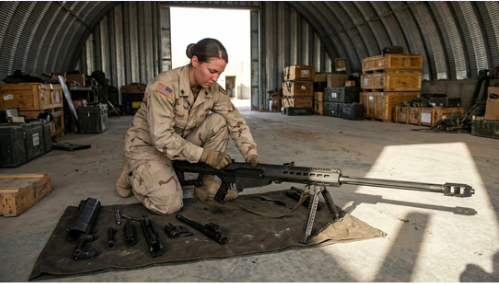
The Barrett M82A1 didn’t belong in a maintenance bay; it belonged in the hands of a ghost. To Maria, the thirty-pound rifle felt like a sleeping beast, cold and honest in a way people never were. She knelt on the concrete of the Kandahar bay, her calloused fingers moving with a rhythm that bordered on prayer.
Click. Slide. Thrum.
She disassembled the bolt carrier group, the metallic music of the .50 caliber components echoing against the corrugated tin walls. Most soldiers saw a weapon of destruction. Maria saw a radiology of choices. Her father, Miguel, had told her once that a rifle was an instrument of precision, no different from a cello or a scalpel. But Miguel hadn’t been at Operation Silent Thunder. He hadn’t seen the way the dust hung in the air after the trigger broke.
“Staff Sergeant Santos,” a voice projected—not a shout, but a vibration that demanded the room’s oxygen.
Maria didn’t startle. She finished wiping a thin layer of grease from the firing pin before looking up. Commander Jake “Reaper” Morrison stood in the doorway, the morning sun framing him in a harsh, white halo. He looked exactly like his reputation: lean, graying at the temples, and possessed of eyes that seemed to be constantly calculating windage.
“Commander,” she said, standing into a stiff parade rest. Her hands, usually steady as stone, felt a faint, phantom itch.
Morrison didn’t look at her face first. He looked at the rifle. He knelt by the disassembled parts, his hand hovering over the bolt. “Most techs treat these like tractors,” he murmured. “You treat this like it’s still alive.”
“It deserves respect, sir,” Maria replied, her throat dry. “Eight hundred rounds through this one since the last breakdown. The barrel is true, and the action… the action is as smooth as silk.”
Morrison looked up then. The blue of his eyes was the color of a mountain lake just before it freezes. “I’ve been reading your file, Maria. The 75th Rangers. Syria. Afghanistan. And then… a sudden request for non-combat duties. No explanation. Just a transfer to the grease and the quiet.”
The ventilation fans hummed, a low, mechanical drone that filled the silence. Maria felt the walls of the bay closing in. She’d spent six months building this sanctuary of oil and metal, trying to bury the memory of a twelve-year-old boy in a mountain pass.
“I serve where I’m needed, sir,” she said, the lie tasting like copper.
Morrison stood, pulling a tablet from his pocket. He swiped a screen toward her. It wasn’t her service record. It was a topographical map of a valley she didn’t recognize, jagged and cruel. “I have a situation. A high-value target nestled in a civilian-heavy compound. An assault is impossible. A drone strike is too messy.”
He stepped closer, his voice dropping to a conspiratorial whisper. “The shot is 3,200 meters. Wind variable. Elevation extreme. My team says it’s a prayer with a ballistic trajectory. But I remember a report from Operation Sandstorm. 3,247 meters. One round. One kill.”
Maria’s heart hammered against her ribs like a trapped bird. “I don’t do that anymore, sir.”
“The way you handle that bolt tells me you never stopped,” Morrison countered. He leaned in, his gaze unflinching. “I don’t need a shooter who wants to kill, Maria. I need a shooter who understands the weight of the finger on the trigger. I need someone who knows what it’s like to fail, because they’re the only ones who will fight to be right.”
He left the tablet on the workbench, the satellite image of the compound glowing like an open wound. Maria looked down at the reassembled Barrett. The crosshairs in her mind were already settling on the valley, but the center of the reticle wasn’t a target.
It was a mirror.
CHAPTER 2: THE KINTSUGI PARTNERSHIP
“The math says we’re lying to ourselves,” a voice said, cutting through the heavy, oil-scented air of the maintenance bay.
Maria didn’t look up from the tablet Morrison had left on her workbench. The satellite imagery of the valley was a tapestry of faded textures—dust-choked roads, crumbling mud-brick walls, and the soft, frayed edges of mountain scrub. It looked fragile, like a piece of ancient parchment that would disintegrate if she touched it too hard.
“The math is fine,” Maria replied, her voice steady. “It’s the wind that lies.”
She finally turned. Standing near a stack of ammunition crates was a woman who seemed carved from the same stubborn teak as the rifle stocks. Petty Officer First Class Sarah Chun was compact, her sleeves rolled up to reveal forearms corded with the kind of lean muscle that came from hauling gear up vertical inclines. Her eyes weren’t just looking at Maria; they were scanning for structural weaknesses.
Chun held up a ruggedized notebook. “I ran the numbers three times on the flight over. At three-thousand-plus meters, the bullet’s flight time is four point two seconds. In that window, the rotation of the earth moves the target. The air temperature at the ridge is twenty degrees lower than the valley floor. The density altitude shift alone is enough to turn a kill-shot into a warning.”
Maria felt a flicker of something she hadn’t felt in months: a shared burden. “And the mirage?”
“Like looking through a funhouse mirror,” Chun said, stepping closer. She set her notebook down next to the disassembled Barrett. “I’m Sarah. Morrison said you’re the only person in this AO who won’t flinch when the scope turns into a kaleidoscope.”
Maria looked at Chun’s hands. They were stained with graphite and ink, the marks of a mathematician who worked in the dirt. “Maria. And I don’t flinch, Sarah. I just… I wait.”
“Waiting is a luxury we won’t have,” Chun said, her tone softening but remaining sharp, transactional. “Morrison wants us wheels-up at 1800. We’re inserting eight klicks out. It’s a vertical climb. If we’re doing this, I need to know we’re calibrated. Not just the rifle. You.”
Maria picked up the Barrett’s bolt carrier. She felt the micro-scratches in the metal, the imperfections that she’d spent all morning trying to smooth away. “I’m as calibrated as I’m ever going to be.”
“Good. Because I’m not just your spotter, Maria. I’m your eyes, your lungs, and your conscience.” Chun reached out, her fingers hovering near the rifle. “I heard about Silent Thunder. In the SEAL teams, we have a word for what you’re carrying. We call it ‘The Ghost Ratio.’ For every soul you take, you carry a piece of them. If you carry too many, you can’t steady the rifle.”
The mention of the incident felt like a cold blade against Maria’s ribs. She didn’t look away. The “Faded Textures” of the room—the yellowed light, the peeling paint on the crates—seemed to pulse. “I only carry one, Petty Officer. And he’s heavy enough.”
Chun nodded, a silent acknowledgment of the scar. She didn’t offer pity; pity was for civilians. She offered a handload—a single .50 caliber round she’d pulled from her vest. The brass was polished to a mirror shine, catching the warm, afternoon light.
“I hand-turned the lathed solids for this mission,” Chun said. “Consistent weight to within a tenth of a grain. If the rifle fails, it’s the metal. If the math fails, it’s me.”
“And if the shot fails?” Maria asked.
Chun looked at the satellite photo of the compound, specifically a small courtyard where a splash of colorful fabric indicated laundry—or perhaps a child’s toy. “If the shot fails, we live with it. That’s the contract.”
Maria took the round. It was warm from Chun’s pocket. She felt the weight of it—the literal and metaphorical gravity of the task ahead. They were two broken pieces of a larger machine, trying to fit together to prevent a catastrophe.
“Eight klicks,” Maria murmured, looking toward the jagged peaks of the Hindu Kush visible through the bay’s high windows. “The air is thin up there.”
“Then we’ll just have to breathe for each other,” Chun replied.
As they began to pack the gear—the spotting scope, the weather station, the heavy, silenced beast of a rifle—Maria noticed a small, silver charm hanging from Chun’s pack. it was a tiny, tarnished compass that didn’t seem to point north. It spun aimlessly in the vibration of the bay’s fans.
“Micro-mystery,” Maria thought, but she didn’t ask. There was enough weight in the room already.
CHAPTER 3: THE RIDGE OF VIGIL
The Hindu Kush did not welcome intruders; it merely tolerated them with a frigid, stony silence. By the third hour of the ascent, the “Faded Textures” of the Kandahar base felt like a fever dream. Here, the world was composed of bone-white shale, pockets of ancient, stubborn snow, and the thin, biting air that burned Maria’s lungs with every ragged inhale.
She could feel the weight of the Barrett secured to her ruck, a familiar, heavy anchor pulling at her shoulders. Behind her, the rhythmic scrape of Chun’s boots against the scree was the only clock that mattered. They moved through the “Atmospheric Zoom” of the high altitude, where the sun didn’t warm the skin so much as it scorched it through a veil of ice.
“Hold,” Maria whispered, the word barely leaving her cracked lips.
She dropped to one knee, melting into the shadow of a jagged limestone overhang. Chun was down a second later, her chest heaving in a controlled, silent rhythm. They had reached the shoulder of the ridge—a natural hide-site nestled among boulders that looked like the teeth of a buried giant.
Chun didn’t speak. She crawled forward on her stomach, dragging the spotting scope bag behind her. Maria followed, the grit of the mountain getting under her fingernails, into her pores. When they reached the edge, the valley floor opened up beneath them, a sprawling canvas of dust and distant, shimmering heat.
“Rangefinder is active,” Chun murmured, her voice a soft rasp. She adjusted the tripod with fingers that remained impossibly steady despite the cold. “Target compound is at twelve o’clock. Range… three-thousand, two-hundred, forty-seven meters. Exactly.”
Maria pulled the Barrett from its case. The metal felt brittle in the cold, a sharp contrast to the warm oil of the maintenance bay. She settled behind the stock, her eye meeting the glass of the Leupold scope. The world collapsed. The vast mountain range vanished, replaced by the intimate, voyeuristic circle of the reticle.
The compound looked like a toy set from this height. Mud-walled buildings, a central courtyard, and the “Faded Textures” of laundry lines. But then, movement. A flash of red.
“I have eyes on civilians,” Maria said, her heart stuttering. “Courtyard. It’s a girl. Red dress.”
Chun was silent for a beat, her eye pressed to the spotting scope. “I see her. And three others. They’re playing near the well. Intel said this was a hardened facility.”
“Intel is never the one pulling the trigger,” Maria countered. She felt the “Ghost Ratio” shifting, the weight of the boy from Silent Thunder pressing down on her neck. She adjusted the parallax, bringing the girl into sharp focus. The child was laughing, chasing a moth through the dust, oblivious to the two shadows perched three kilometers above her head.
Chun reached into her pocket and pulled out the spinning silver compass Maria had noticed earlier. She set it on a flat rock between them. It didn’t point north; it vibrated, the needle dancing toward the valley floor as if pulled by an unseen tide.
“The wind is spiraling,” Chun observed, ignoring the strange behavior of the compass. “We have a cross-canyon gust at seven knots, but there’s a thermal rising from the valley floor that’s going to lift the round. It’s a beautiful, broken mess, Maria.”
Maria didn’t answer. She was watching a man emerge from the main building. He moved with a slow, heavy authority, guarded by two men with slung rifles. Ahmad Nazir. Through the high-powered glass, his beard looked silver, his eyes deep-set and weary. He didn’t look like a monster. He looked like a man tired of a long war.
“Target identified,” Chun whispered. “Ahmad Nazir. He’s stationary by the western door.”
Maria’s finger found the trigger guard. The metal was ice-cold. She felt the shared burden of the ridge—the silence between her and Chun, the weight of the custom-lathed round in the chamber, and the laughter of the girl in the red dress echoing in her mind.
“Wait,” Maria whispered, though Nazir was perfectly centered. “The girl is too close to the line of over-penetration.”
“The window is opening, Maria,” Chun warned, her voice devoid of pressure, merely stating a ballistic fact. “The sun is hitting the canyon wall. In five minutes, the mirage is going to wash out the courtyard. We won’t be able to see the girl or the target.”
Maria breathed out, a slow, shimmering plume of mist. She watched the girl in red trip and fall, then scramble back up, her small hands coated in the same dust that Maria was currently inhaling. The “Micro-Mystery” of the spinning compass flickered in her peripheral vision—a reminder that in this valley, nothing followed the expected map.
“I’m not taking it yet,” Maria said, her voice a jagged stone. “We watch. We wait for the texture to change.”
CHAPTER 4: THE GHOST AT THE TRIGGER
The sun didn’t just set in the Hindu Kush; it bled out, staining the shale in “Faded Textures” of bruised violet and burnt ochre. For thirty-six hours, the world had shrunk to the diameter of a thirty-four-millimeter tube. Maria’s pulse was a slow, rhythmic ghost in her ears, timed to the minute oscillations of the crosshairs as they danced over the target compound.
Beside her, Chun was a statue of grit and carbon fiber. The “Micro-Mystery” of the silver compass between them had finally stilled, its needle fixed not on north, but directly toward the compound’s central well. It was a magnetic anomaly, or perhaps something deeper—a pull toward the center of the storm.
“Movement,” Chun whispered, the word barely disturbing the frost on her lips. “Second floor. Conference room. Nazir is seated. He’s… he’s pouring tea.”
Maria adjusted the parallax. The clarity was agonizing. She could see the steam rising from the glass—a warm, domestic detail in a theater of war. Through the glass, Nazir looked soft. He was leaning in, speaking with an intensity that lacked the jagged edges of a killer. He looked like a teacher, or a grandfather, his hands moving with the same “Faded Texture” of grace Maria remembered from her father.
“Wind check,” Maria murmured.
“Dropping. Six knots from the southeast. Thermal lift is neutralizing as the ground cools. Maria… this is the cleanest solution we’ve had in two days.” Chun’s voice was guarded, a quiet vulnerability creeping into the tactical report. “The girl in red is in the north building. She’s sleeping. The courtyard is empty.”
Maria felt the weight of the Barrett settle into the pocket of her shoulder. It wasn’t a weapon anymore; it was a bridge. At 3,247 meters, the bullet would be a messenger. She squeezed the grip, her finger finding the cold curve of the trigger.
The rifle doesn’t make the decision, Mija. The rifle just delivers the consequence.
Her father’s voice was so clear it felt like he was lying in the dirt beside her. She watched Nazir through the scope. He reached into his pocket and pulled out a small, tattered book—not a ledger of targets, but something that looked like poetry. He began to read aloud to the men at the table.
“I have the shot,” Maria whispered. “Range confirmed. Windage held. Lead is zero.”
“Take it,” Chun breathed. “Before the light fails completely.”
Maria’s world narrowed. The “Ghost Ratio” flared—the twelve-year-old boy from Silent Thunder stood in the corner of her vision, his toy rifle catching the dying light. She looked at Nazir. She looked at the tea. She looked at the way his advisors nodded, not in fear, but in a strange, shared solemnity.
Then, the girl in the red dress appeared in the window below him. She wasn’t playing. She was carrying a lamp, its warm glow illuminating the “Faded Textures” of the mud wall. She looked up at the window where Nazir sat, and she smiled.
Maria’s finger tightened. The sear was a hair’s breadth from breaking. The 3,247-meter trajectory was a mathematical certainty. The lathed solid round was ready to shatter the glass and the man behind it.
“Maria?” Chun’s voice was sharp now. Transactional. “He’s standing. He’s moving toward the center of the frame. Now.”
Maria watched the lamp in the girl’s hand. If the bullet over-penetrated—and at this range, it would—the kinetic energy wouldn’t just stop at Nazir. It would carry through the floor, through the ceiling of the room below, through the fragile light held by the child.
“No,” Maria said.
The word was a tectonic shift. She didn’t just hold the shot; she eased the pressure off the trigger completely. She felt the “Kintsugi” of her own mind—the cracks where the light got in—expanding.
“Target is mobile,” Chun reported, her voice flat with confusion. “Maria, he’s right there. The courtyard is clear. The wind is dead. Why didn’t you break?”
“Because the light was wrong,” Maria replied. She didn’t look away from the scope, watching as the girl in red reached the second floor and handed the lamp to Nazir. He kissed the top of the child’s head.
The “Midpoint Twist” wasn’t a tactical betrayal or a hidden bomb. It was the realization that the target wasn’t a target. He was the anchor.
“Look at the compass, Sarah,” Maria whispered.
Chun looked down. The silver needle wasn’t spinning anymore. It was pointing with absolute, unwavering precision at the lamp Nazir was now placing on the table. It wasn’t a magnetic pull. It was a signal.
“He’s not coordinating an attack,” Maria realized, her voice trembling with the weight of the “Shared Burden.” “He’s coordinating a sanctuary.”
CHAPTER 5: THE INVISIBLE SHOT
The valley below began to dissolve into a soft, bruised grey as the sun dipped behind the jagged spine of the Hindu Kush. Through the scope, the “Faded Textures” of the compound became a series of glowing amber portals where lamps had been lit. Maria watched the heat signature of the tea glass in Nazir’s hand fade slightly, a tiny star in a vast, dark sea.
The “Invisible Shot” was the hardest one she had ever taken. It required no trigger pull, only the agonizing stillness of the finger held in check while every tactical instinct screamed for resolution.
“Convoy is moving,” Chun whispered, her voice tight with the “Shared Burden” of their discovery. “Lead vehicle is idling. The girl is waving from the gate, Maria. She’s waving goodbye.”
The silver compass between them flared once, the needle spinning a wild, frantic circle before settling toward the east—the direction of the mountain passes, and the deeper secrets they held. The “Micro-Mystery” of the device seemed to pulse in rhythm with Maria’s own heart, a heartbeat that was no longer a mechanical metronome for a killer, but a heavy, organic thrum.
“Actual, this is Overwatch,” Maria said into her comms, her voice a rough whisper that barely carried over the mountain wind. “Target Alpha is mobile. He is departing with a non-combatant escort. I am… I am standing down.”
The silence on the other end of the radio was a physical weight. She could almost hear the gears turning in the Tactical Operations Center, the “System” struggling to process a sniper who had found something more important than a confirmed kill.
“Overwatch, repeat,” Morrison’s voice crackled back, stripped of its usual warmth. “You have a clear window. The courtyard is empty. Why are you not engaging?”
“The map is wrong, sir,” Maria replied, her eyes never leaving the girl in the red dress, who was now just a small, flickering shadow in the twilight. “He’s not the architect of the attacks. He’s the shield for the schools. If I take him, the sanctuary breaks.”
Beside her, Chun reached out, her hand resting briefly on the stock of the Barrett. It was a gesture of “Guarded Vulnerability,” a silent confirmation that they were no longer just a shooter and a spotter, but two witnesses to a truth the briefing had ignored.
“The vehicles are entering the pass,” Chun reported, her eye still pressed to the spotting scope. “They’re gone, Maria. He’s gone.”
Maria pulled back from the rifle. The world rushed back in—the cold, the biting wind, the smell of ancient dust and shale. She felt a strange lightness, as if the “Ghost Ratio” that had haunted her since Operation Silent Thunder had finally balanced its books. The boy in the pass was still there, but he was no longer a weight; he was a reminder that mercy was a form of precision, too.
She began to disassemble the rifle with practiced, rhythmic motions. The metal felt different now—less like a predator’s tool and more like the “Kintsugi” pottery she had seen in books, where the breaks were filled with gold. Her hands were steady.
“We’re going to have a lot to explain,” Chun said, her gaze fixed on the spinning silver needle of the compass. “Morrison won’t take ‘instinct’ for an answer.”
“He doesn’t have to,” Maria said, looking at the tattered satellite map. She saw the frayed edges of the villages, the small dots of schools that the “Protocol” had labeled as collateral risks. “The math was right, Sarah. We just had the wrong equation.”
As they packed the gear into the rucks, the valley fell into total darkness. The only light left was the faint, nostalgic glow of the base far to the south, a “Faded Texture” of a world that demanded certainties Maria could no longer provide. She shouldered the heavy case, the weight of the rifle feeling like a shared secret between her and the mountain.
“Ready?” Chun asked, her silhouette a sharp shadow against the rising moon.
“Ready,” Maria replied.
They began the long, vertical descent. Every step was a jarring reminder of the “Rusted Truth” of the world, but as they moved, Maria felt a sense of peace she hadn’t known in years. She hadn’t fired a single round, yet she felt like she had finally hit the center of the target.
CHAPTER 6: THE REDEFINED PRECISION
The fluorescent lights of the Kandahar operations center hummed with a sterile, “Faded Texture” that made Maria’s eyes ache. After the vast, bruising violet of the mountains, the world felt too small, too bright, and too loud. She stood at the edge of the map table, her skin still caked with the white shale dust of the ridge, her hands—once the most precise instruments in the regiment—heavy at her sides.
Morrison was there, a silhouette against a wall of glowing monitors. He didn’t look angry; he looked like a man trying to read a language that had suddenly changed its alphabet.
“You had three windows,” Morrison said. He didn’t turn around. “Chun’s data logs show stable wind, clear line of sight, and a target that remained stationary for one hundred and twelve seconds. And yet, the only thing you brought back was a full magazine.”
“The precision wasn’t in the shot, sir,” Maria said. Her voice felt like rusted wire. “It was in the restraint.”
She stepped forward, the “Guarded Vulnerability” of the moment pressing in on her. She reached into her pocket and pulled out the silver compass Chun had left with her during the extraction. She set it on the digital map, right over the valley coordinates. The needle didn’t spin this time. It settled, pointing toward a small, unlabeled cluster of structures five kilometers east of the primary compound.
“Nazir wasn’t planning an offensive,” Maria continued, her gaze steady on the back of Morrison’s head. “He was moving supplies. Medical crates. Textbooks. The meeting wasn’t a council of war; it was a negotiation for a corridor of safety. If I had pulled that trigger, the ‘Ghost Ratio’ wouldn’t have just been one man. It would have been every life that sanctuary was meant to protect.”
Morrison turned then. The warm light of the monitors reflected in his eyes, softening the “Sharp Edges” of his command. He looked at the compass, then back at Maria.
“I know,” he said quietly.
The words hung in the air, a “Midpoint Twist” that Maria hadn’t prepared for.
“You knew?”
“I received the updated intelligence intercept twenty minutes after you went silent on the ridge,” Morrison explained. He walked toward her, his boots silent on the deck. “I wanted to see if you would see it. Most shooters, Maria, they see a target and they see an ending. They want the closure of the recoil. But the kind of precision I need… it’s the kind that can tell the difference between a threat and a foundation.”
He picked up the silver compass. “This wasn’t just a test of your eye, Staff Sergeant. It was a test of your soul. You were broken after Silent Thunder because you followed the ‘System’ instead of the truth. Today, you fixed that.”
Maria felt a sudden, sharp sting behind her eyes—the “Kintsugi” of her own heart finally setting. The cracks were still there, the memory of the boy in the pass would always be there, but the gold was finally starting to hold.
“I’m not a ghost anymore, sir,” she whispered.
“No,” Morrison agreed. He handed her a new set of orders, the paper feeling crisp and real against her calloused skin. “You’re a guardian. And we have a lot of work to do.”
Maria walked out of the command center and back toward the maintenance bay. The smell of gun oil greeted her like an old friend, but as she picked up the Barrett to begin its final cleaning, she didn’t feel the need to lose herself in the mechanics. She felt the weight of the choice she had made, a choice that was as solid and undeniable as the mountains she had just left behind.
She looked at the rifle, then out the window at the first light of dawn breaking over the peaks. The world was still messy, still “Rusted” and “Faded,” but for the first time in years, the crosshairs were clear.