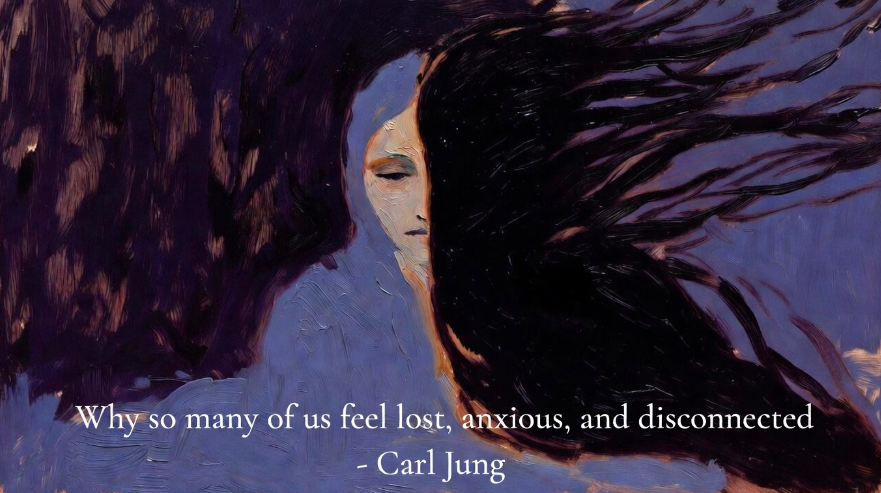
🗣 Why so many of us feel lost, anxious, and disconnected – Carl Jung
In the stillness that descends upon a life as the years lengthen, when the outer world has grown quieter and the inner one more insistent, a subtle voice may begin to speak. It does not shout; it waits. It is the part of us that feels small, unfinished, perhaps envious of what others seem to possess so easily—vitality, certainty, completion. This part longs, not for the applause of the world, but for simple recognition from the one who has carried it all these decades: oneself. The more one turns away from it, the more it stirs beneath the surface, coloring attractions that puzzle the mind, irritations that flare without clear cause, patterns of behavior that repeat like old, weary habits one cannot quite shake. By day, life proceeds in its accustomed order: roles are performed, coherence maintained, responsibilities met. Yet in the night, when masks fall away and silence envelops the room, a quieter question emerges: Why does something essential within still feel untouched, unclaimed?
Carl Jung, whose gaze rested long upon these hidden regions of the soul, named this exiled aspect the shadow. It is not evil in the conventional sense, nor something to be ashamed of in a superficial way. It is simply what has been unseen, what the conscious personality has deemed incompatible with the image one has built and defended over a lifetime. The shadow gathers what has been rejected: impulses toward weakness when strength was demanded, desires that seemed selfish amid duties, aggressions softened for the sake of peace, vulnerabilities armored against exposure. These are not mere flaws to be corrected; they are parts of the human whole, carrying energies that, when denied, do not vanish but exert their influence from the background. As Jung observed in his reflections on the phenomenology of the self, the shadow is a moral problem that challenges the entire ego-personality, for to become conscious of it requires considerable moral effort—no small thing to recognize the dark aspects as present and real, not distant aberrations but integral to one’s being.
This avoidance of self-confrontation was something Jung witnessed repeatedly in his practice and in the broader currents of modern existence. People, he noted, would construct elaborate distractions, plunge into destructive patterns, even manufacture crises rather than sit quietly with their own thoughts. The soul—what he termed the Self, that deeper center holding truths, purpose, and the potential for wholeness—remains unapproached. Instead, one projects the inner darkness outward: onto others who become bearers of what one cannot bear in oneself, onto circumstances blamed for inner unrest, onto pursuits of material security or endless activity that promise fulfillment yet leave an abiding emptiness. The irony is stark: happiness is sought everywhere except in the one place where it might truly be found. We run from the soul we carry, preferring the surface noise to the depth that calls.
In an age of infinite distractions—devices that fill every pause, algorithms that anticipate and feed every restlessness—the flight has only intensified. Anxiety rises, depression deepens, a sense of existential void persists despite outward abundance. Jung, writing in works such as Modern Man in Search of a Soul and Psychology and Alchemy, saw this not as mere misfortune but as the consequence of refusing the inner journey. The psyche, he insisted, will not be appeased by external remedies. What is repressed returns in disguised forms: in compulsions, in projections that poison relationships, in the quiet dissatisfaction that shadows even moments of apparent success. The patterns one cannot break are often the shadow’s way of insisting on attention. Attractions that feel irrational may draw one toward what has been disowned; irritations that flare disproportionately point to mirrors of the self.
Yet Jung did not speak only of loss. He pointed to a path, arduous yet transformative: the integration of the shadow within the larger process he called individuation. Individuation is the lifelong unfolding toward wholeness, not perfection but completeness—the harmonious relation of conscious and unconscious, ego and Self. It begins with the realization that what we exile does not disappear; it shapes us from behind the curtain. To integrate the shadow is to turn toward it, not with condemnation, but with the patient effort to make the darkness conscious. One does not become enlightened, Jung wrote, by imagining figures of light, but by making the darkness conscious. This procedure is disagreeable and therefore not popular. It demands facing what has been hidden: acknowledging envy without self-loathing, owning anger without acting it out destructively, reclaiming creative impulses long suppressed by duty. The shadow, when met in this way, reveals not only what is troublesome but what is vital—energies of instinct, passion, authenticity that the conscious personality has excluded in its adaptation to the world.
The process is slow, often painful. It involves moral effort: the humility to see one’s contradictions, the courage to endure the discomfort of self-knowledge. Jung described the shadow as displaying an emotional and primitive nature that resists easy control. Its contents, drawn from personal experience and deeper archetypal layers, carry a charge that intellectual understanding alone cannot diffuse. Recognition must be accompanied by feeling; one must grasp the shadow not merely as concept but as lived reality. In this encounter, projections lessen. The faults one once attributed so readily to others begin to appear as echoes of one’s own disowned parts. Relationships, once fraught with misunderstanding, may soften into greater authenticity. The inner war quiets, replaced by a growing sense of coherence.
For those in the later years, when the first half of life—its adaptations, achievements, responsibilities—has yielded to a different rhythm, this work assumes a particular gravity. Many have spent decades in service to roles, to expectations, to the maintenance of an outer order. Now, with time’s gentle insistence, the psyche may speak more clearly. Dreams grow vivid, carrying symbols of what has been neglected; moods arise unbidden, pointing to unfinished business; a subtle longing emerges for something deeper than accumulated security. This is no accident. Jung saw the second half of life as naturally oriented toward individuation, toward the integration of what was set aside in youth’s necessary outward focus. The presence some carry in age—that quiet gravity, that depth others sense without words—often arises from having turned toward what most spend a lifetime avoiding.
To undertake this confrontation requires no dramatic upheaval. It is a matter of attention: noticing when irritation arises and asking what it mirrors within; reflecting on recurring dreams as messages from the depths; allowing desires once judged unacceptable to enter awareness without immediate judgment. The shadow, once met, ceases to be an opponent and becomes a part of the whole. It brings not chaos but vitality. Wholeness emerges not from eradicating darkness but from including it—recognizing that light and shadow belong together, that imperfection is the condition of psychic reality. As Jung noted, there is no light without shadow, no psychic wholeness without imperfection.
In this turning, the question that once haunted the night shifts. The part that felt small and unfinished begins to feel seen—not by acclaim from without, but by the quiet acceptance from within. Patterns once unbreakable soften as their roots are acknowledged. The soul, long avoided, is met at last. Not with fanfare, but with the dignity of one who has chosen, in the evening of life, to live more fully what one has always been.
This is not self-improvement in the ordinary sense, with its promises of quick elevation. It is the patient work of wholeness, the reconciliation of what was split. In facing the shadow, one reclaims what was projected, withdraws what was imposed upon others, and steps toward the Self—that regulating center beyond the ego, guiding toward a life that feels, at last, authentic and complete. The presence that results is not loud; it is deep. It carries the gravity of one who has looked into the abyss within and found not destruction, but the fuller human truth.
In the quiet reflection of later years, this possibility remains open. The soul waits—not to judge, but to be known. To turn toward it is to honor the journey’s deepest call: not to escape the darkness, but to bring it into the light of consciousness, where it may find its place in the whole. In that integration lies not merely relief from suffering, but the quiet fulfillment of becoming who one truly is.