Goodbye June: Kate Winslet’s Devastating Directorial Debut Is the Heartbreaking Netflix Family Drama Everyone Is Talking About

Netflix has just delivered what many viewers are already calling one of the most emotionally devastating family dramas of the year — a film so raw, so intimate, and so unflinchingly honest about love, regret, and loss that audiences report pausing mid-stream just to catch their breath. At the center of this quiet storm is a major career milestone for Oscar-winning actress Kate Winslet: her feature directorial debut, Goodbye June.
Released in select theaters on December 12, 2025, and arriving on Netflix on Christmas Eve, the film stars a powerhouse ensemble led by Helen Mirren as the dying matriarch and Downton Abbey and Ted Lasso favorite Jeremy Swift in a supporting role. What begins as a seemingly perfect Christmas reunion quickly unravels when a mother’s sudden health crisis forces four adult siblings and their father to confront decades of buried secrets, painful memories, and emotional scars that never truly healed. The result is a story of family, regret, forgiveness, and loss that hits harder than almost anyone expects.
A Personal Story Turned Universal
The origins of Goodbye June are deeply personal. The screenplay was written by Winslet’s son, Joe Anders, then just 19 years old and studying at the National Film and Television School. Inspired by the death of Winslet’s own mother from ovarian cancer in 2017, Anders crafted a story that is not strictly autobiographical but draws heavily from the emotional atmosphere of that time. Winslet has spoken openly about how the script felt like a gift — and a challenge. She had not planned to direct, but after reading her son’s work she felt compelled to step behind the camera, in addition to producing and starring in the film.
“It is about family, not just about death,” Winslet has said. That philosophy permeates every frame. The film never wallows in misery for its own sake. Instead, it finds room for sharp humor, awkward silences, sibling sniping, and the small, everyday acts of care that define real families under pressure.
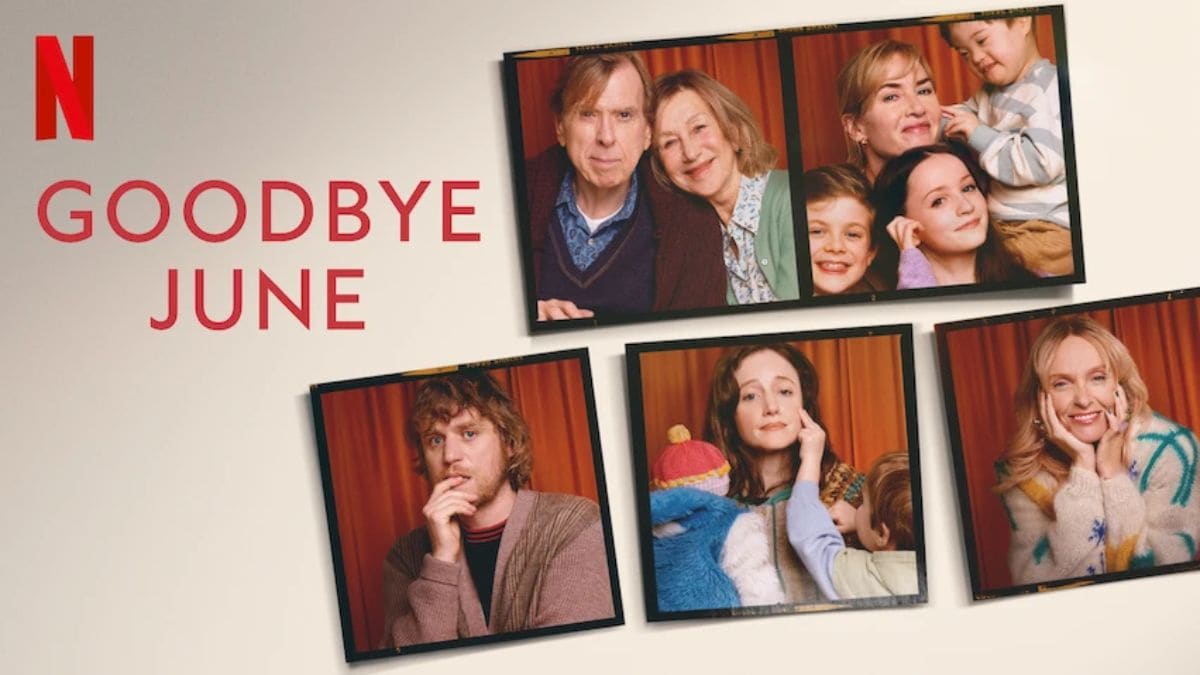
Set in the two weeks leading up to Christmas, the story opens with June Cheshire (Helen Mirren), a quick-witted, no-nonsense mother, collapsing at home. Rushed to hospital, she learns her cancer has progressed aggressively. Doctors doubt she will make it to the holiday. Her four adult children scramble to her bedside: successful but tightly wound Julia (Kate Winslet), free-spirited and slightly eccentric Helen (Toni Collette), financially struggling and long-estranged Molly (Andrea Riseborough), and directionless younger brother Connor (Johnny Flynn), who still lives at home. Their father, Bernie (Timothy Spall), a cantankerous man who prefers beer and silence to emotional expression, hovers awkwardly in the background. Jeremy Swift appears as Dr. David Titford, one of the physicians navigating the family’s turbulent reactions.
What follows is not a grand, sweeping epic but a tightly focused chamber piece that mostly unfolds in a single hospital room. The siblings bring their messy lives with them — old grudges, unspoken resentments, competing parenting styles, and wildly different ways of processing grief. Julia and Molly have barely spoken in years. Helen arrives from Germany scattering sage and talking about holistic healing. Connor seems paralyzed by the prospect of losing the one person who has always anchored him. And Bernie… well, Bernie drinks beer in the corner and pretends everything is fine.
The Emotional Core: When the Perfect Reunion Cracks
The film’s genius lies in how it lets the family’s carefully constructed Christmas facade crumble in real time. Early scenes of forced cheer — grandchildren running around, attempts at festive decorations in a sterile hospital room — give way to raw confrontations. A doctor’s blunt diagnosis triggers an explosion of anger from Molly. Julia freezes in quiet devastation. Connor finally confronts his father’s emotional unavailability. June herself, razor-sharp even as her body fails, orchestrates moments of brutal honesty and unexpected tenderness. She wants her daughters to reconcile. She wants her son to find his footing. She wants her husband to look her in the eye and really see her one last time.
One of the film’s most devastating sequences involves June watching snow fall outside her window and quietly asking her daughter for permission to let go. Another sees the family staging an impromptu nativity play for her — a chaotic, loving, imperfect performance that is interrupted by the inevitable. These moments are not subtle. Critics have noted that the film “stacks the deck for tears a little too lopsidedly.” Yet the honesty of the performances keeps the sentimentality from tipping into pure manipulation.
:max_bytes(150000):strip_icc()/Goodbye-June-Kate-Winslet-and-Helen-Mirren-120925-6d85d452eb5d4433abfe4ceb308d3e74.jpg)
Helen Mirren delivers what many are calling one of the finest late-career performances of her extraordinary life. Stripped of glamour — thin hair, no makeup, a stooped walk when she manages to leave the bed — she plays June with fierce dignity, biting humor, and flashes of profound vulnerability. There is a scene late at night, after the family has left, where she simply lies in the dark with tears sliding down her face. It lasts only seconds, but it is unforgettable. Mirren has said she “didn’t like” playing a dying woman, yet she makes every moment of June’s decline feel lived-in and true.
Kate Winslet, directing herself for the first time, gives a masterclass in controlled heartbreak as Julia. Her scenes opposite Mirren crackle with the complicated love of adult daughters and aging mothers. Toni Collette brings eccentric warmth (and some much-needed comic relief) as Helen. Andrea Riseborough is a revelation as the prickly, exhausted Molly — her long-simmering rage at her sister feels painfully authentic. Johnny Flynn, with his shaggy hair and haunted eyes, quietly steals several scenes as the son who has never quite grown up. Timothy Spall’s Bernie is a masterclass in repressed British masculinity, and Jeremy Swift’s doctor provides a calm, professional counterpoint to the family’s chaos.
Behind the Camera: An Intimate Production
Winslet’s directorial style is deliberately unflashy. Working with a small crew over just 35 days and a modest budget, she prioritized intimacy. She used small microphones on the actors instead of traditional boom mics to create a more natural atmosphere. Cinematographer Alwin H. Küchler’s camera glides gently into close-ups, lingering on faces rather than grand compositions. First-time department heads — composer Ben Harlan, production designer Alison Harvey, costume designer Grace Clark — were given opportunities, reflecting Winslet’s stated belief in “lifting people up.”
The result feels handmade and personal. There is none of the glossy sheen of a big studio holiday movie. Instead, the film has the lived-in texture of a family home — messy, loud, full of unfinished conversations and half-eaten snacks. The Christmas setting is both a blessing and a curse: it amplifies the emotional stakes while occasionally tipping the film into familiar tearjerker territory. Yet Winslet’s restraint and the cast’s brilliance keep it grounded.
:max_bytes(150000):strip_icc()/Goodbye-June-121525-2a7b53965d994f719e422599b83d5c3c.jpg)
Themes That Linger Long After the Credits
At its heart, Goodbye June is about the things families leave unsaid until it is almost too late. It explores how grief can both fracture and heal. It examines the different ways people love — some through practical competence, some through spiritual rituals, some through quiet presence, some through explosive honesty. It asks whether true forgiveness is possible after years of silence, and whether a “good goodbye” can rewrite a lifetime of imperfect love.
The film also captures the particular cruelty and beauty of a Christmas death. The forced cheer of the season collides with the reality of loss in ways that feel almost unbearably true. Viewers who have lost parents, especially around the holidays, have described the experience as both cathartic and retraumatizing. Many report watching through tears, laughing through sobs, and then sitting in silence for long minutes after the final frame.
One year later, the film’s coda offers a gentle, hopeful note: the family gathered again at Christmas, new life in the form of a baby, old wounds softened if not fully healed. June’s voiceover letter to her unborn grandchild — a meditation on a life well-lived simply by being part of a family — lands like a quiet benediction. Snow falls. Children run to the window. Life, somehow, continues.
Reception: Tears, Praise, and a Few Reservations
Critics have been largely positive if not ecstatic. On Rotten Tomatoes the film sits at 64% from critics, with the consensus praising the “honest performances” that put the drama’s “heart firmly in the right place” even when the tearjerking feels calculated. The Hollywood Reporter called it “a predictable but warm heart-tugger” redeemed by its stellar ensemble. Audience scores and social media reactions have been far more enthusiastic. Viewers describe it as “one of the most heartbreaking watches of the year,” “a beautiful mess of a family,” and “the kind of film that forces you to call your own parents.” Many admit they had to pause just to process the emotional weight.
Some have found the sentimentality overwhelming or the character arcs a touch too neat. Others celebrate exactly that neatness as a gift — a rare film that offers catharsis rather than unresolved despair. What almost no one disputes is the caliber of the acting or the sincerity of Winslet’s direction. For a first-time filmmaker, she shows remarkable confidence and emotional intelligence.
A Milestone Worth Celebrating
Goodbye June marks more than just another Netflix original. It is the moment Kate Winslet — already one of the finest actors of her generation — stepped fully into the dual role of storyteller and steward of a deeply personal vision. That she did so with her son’s words, surrounded by some of the best British acting talent working today, feels almost fated.
In an era of franchise fatigue and algorithm-driven content, here is a small, human-scale film about ordinary people facing the most ordinary and most profound of human experiences: saying goodbye. It does not reinvent the wheel. It does not need to. It simply looks unflinchingly at love in all its messy, incomplete, fiercely resilient forms — and in doing so, it breaks your heart open and then gently helps you put it back together again.
If you are looking for light holiday fare, keep scrolling. But if you are ready to feel something real — to laugh, to cry, to remember your own imperfect family with a little more tenderness — then Goodbye June is waiting. Just keep the tissues close. You will need them. And when the credits roll, you may find yourself doing exactly what so many viewers have done: pausing, breathing, and quietly reaching for the phone to call someone you love.
Because that, in the end, is the film’s greatest gift. It reminds us that the power of a good goodbye is not just about the one leaving. It is about remembering to love each other while we are still here.