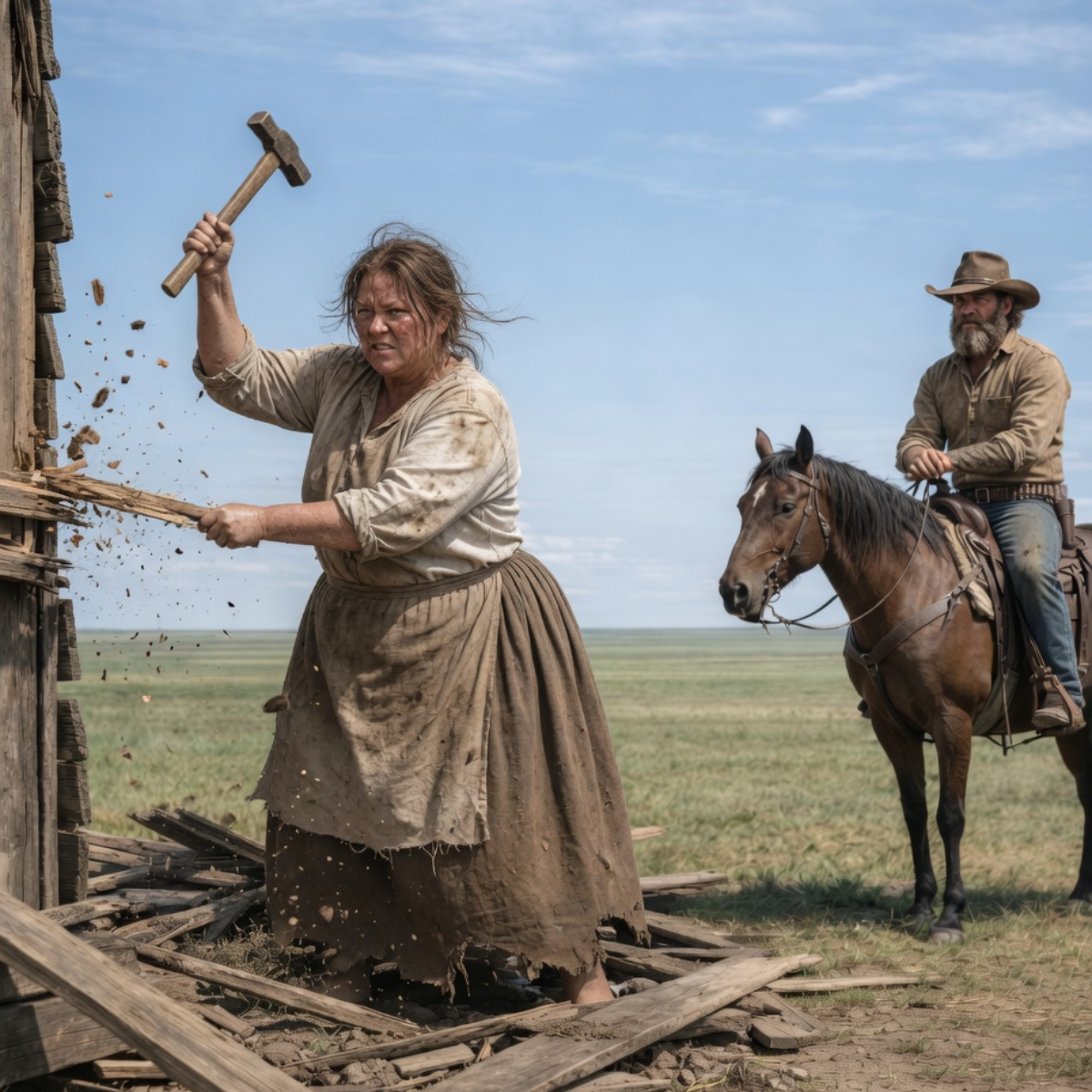
He Replaced Her Before She Even Arrived. So She Stayed, Built a Home from Ruins, and Unearthed the Secret That Could Destroy Him.
Eleanor Hart stepped off the stagecoach in Mesquite Crossing with fifty-two dollars, a worn carpetbag, and the letter that had brought her fifteen hundred miles from Springfield, Illinois.
She was not the first woman Silas Boone had written to. She would not be the last he tried to erase.
“I’m Eleanor Hart,” she told the shopkeeper when he asked where she had come from. Something flickered across his face — recognition edged with discomfort.
“You planning to stay out there?” he asked as he wrapped her nails in brown paper.
“That depends,” she replied. “Is there a law against stubbornness in this county?”
The corner of his mouth twitched. “Not yet.”
Behind her, two women entered the store and whispered loud enough for her to hear:
“That’s her.” “The one he wrote to.” “Lord help her.”
Eleanor laid her coins on the counter one by one. She now had forty-one dollars left in the world. She asked for canvas “for a door that wants to die,” bought beans, flour, coffee she could barely afford, and hauled everything back to the ruined homestead before dark.
She walked the property line in the fading light, taking inventory the way her father had taught her: what could be saved, what had to be replaced, where the well might be, which fence posts had surrendered. Her hands bled before she was finished.
She tore a strip from her underskirt, wrapped her palm, and was levering a heavy beam into place with her shoulder when she heard the horse.
“You keep pushing that way,” a deep voice called, “and that beam’s going to crush you.”
Eleanor gritted her teeth. “Then don’t stand there preaching. Come hold the other end.”
Boots hit the ground. A tall, sun-browned man appeared — lean at the waist, broad through the chest, steady-eyed. He took the beam without another word. Together they raised it, and she drove the nail home.
When it held, she stepped back, breathing hard.
“Name’s Wyatt Reed,” he said. “My ranch is north of here.”
“Eleanor Hart. I’m the woman fixing the roof Silas Boone walked away from.”
Wyatt studied the half-collapsed house, then her bleeding hands. Respect flickered in his eyes — quiet, hard-won respect.
He didn’t leave. He stayed and helped without taking over. He held crates steady when she balanced on them, warned her about rotten posts, and showed her where the real weight belonged. At dusk, he handed her his canteen and offered water from his well until she could clear her own.
“Because somebody should,” he said simply when she asked why he was helping.
Then he rode north, leaving her standing in the red evening light with something dangerous stirring in her chest.
She refused to call it hope. She called it useful.
For the next week, Eleanor worked like a woman trying to outrun betrayal. She patched the roof, squared the doorframe, hung canvas, and hauled water until her shoulders screamed. The town began to arrive in quiet pieces — bread, hinges, spare tools, and cautious kindness. Wyatt rode the north fence line most evenings. He never presumed. He simply showed up.
Then Roy Ketchum arrived — Silas Boone’s enforcer — and told her she had two weeks to leave.
Eleanor climbed down the ladder, hammer still in her hand. “Tell Silas the roof’s already in better shape than the character he left in it.”
She sat down the moment Roy disappeared over the rise because her knees gave out. Then she stood up, picked up the hammer, and went back to work.
That was the day everything changed.
With help from Wyatt and a sharp young lawyer named Daniel Shaw, Eleanor learned the truth: the land Silas had promised her had never truly belonged to him. The deed transferring it from Gideon Hale’s widow had been forged. Silas had built twenty years of ownership on a lie.
And he was not the only one who knew it.
On the tenth day, during a savage storm, June Boone — Silas’s young wife — showed up at Eleanor’s door soaked to the skin, clutching the original land grant and the damning forged transfer she had taken from her husband’s hidden desk.
“I’m not doing this because I’m brave,” June whispered. “I’m doing it because staying silent scares me more.”
Eleanor took her trembling hands. “You’re not alone now.”
The hearing was packed. The whole town turned out — everyone Silas had ever cheated or intimidated. Daniel presented the evidence. June testified. Eleanor took the stand and spoke with calm, scarred precision, reading every repair, every date, every nail from her notebook.
Then Roy Ketchum walked into the courtroom and changed sides.
He stood before the judge and confessed everything: how he had witnessed the forgery as a young man and spent twenty years helping the Boone family bury their wrongs. Silas’s empire cracked open in public.
The judge froze any attempt to remove Eleanor and ordered a federal review of the title.
Outside on the courthouse steps, Thomas Hale — Gideon’s son — told Eleanor that if the fraud was overturned, the land would return to homestead status. She could file and make it hers.
For the first time since leaving Illinois, Eleanor felt the future open its hands instead of slapping her face.
That evening, back in the small house she had dragged back from ruin board by board, she burned Silas’s cold letter in the stove. The words Found somebody local. Don’t come. curled into black ash.
She tucked the lawyer’s letter between the pages of her notebook — the one full of dates, nails, sweat, and witnesses.
Outside, she heard a horse approaching at an easy pace along the north fence line. Not passing through. Coming back.
Eleanor smiled to herself in the quiet room that was no longer a shack. Her scarred hands rested open in her lap — strong, useful, proud.
She had come to Texas as a replaced bride. She had stayed as a builder. She had stayed as a woman who refused to disappear.
And somewhere between the first crooked beam and the final truth, she had built more than a home.
She had built the beginning of the life she was always meant to live.